Yes, Maya is still spoken, and you will hear it around Cancún if you listen. Yucatec Maya, usually just called maya in Mexico, is the second most spoken Indigenous language in the country after Náhuatl, with about 779,000 speakers in INEGI's 2025 intercensal survey. In Quintana Roo, around one in nine residents speaks an Indigenous language.
You do not need to learn the language to enjoy your trip. But a few words, a simple greeting and a little understanding of how it sounds will help you read place names, understand menus, and show respect to the people whose land this is. Below are the words travelers actually run into, plus phrases you can use with confidence.
Is Maya still spoken in Yucatán and Quintana Roo?
Yes, but it is under pressure. According to INEGI data, the state of Yucatán counted about 520,000 Maya speakers in 2020, down from roughly 545,000 a decade earlier. In 2025, about 21 percent of Yucatán residents spoke an Indigenous language, one of the highest shares in Mexico, and Quintana Roo, at 11 percent, was also in the national top ten.
The worrying trend is age. Speakers are increasingly older adults, and fewer children learn Maya at home. Every visitor who shows interest in the language, even with a single word, sends a small signal that it is valued.
A quick note on terms: Maya is the people and the culture, and Yucatec Maya is one language. Mayan is mainly used by linguists for the whole family of related languages spoken in Mexico, Guatemala, Belize and neighboring countries. K'iche', the language of the Popol Vuh, is one of them. Across the region, millions of people speak a Mayan language today.
How do you pronounce Yucatec Maya?
Most letters sound much like Spanish. These are the differences that matter most:
- x sounds like English sh. Xunáan kaab is "shoo-NAHN kahb," and Bix is "beesh."
- j sounds like English h, as in Spanish. Older spellings used h instead, which is why you will see ha' and ja' for "water," or h-men and j-men for a traditional ritual specialist.
- Apostrophe after a consonant (k', ch', t', p', ts') marks an ejective: a sharper, popped version of the sound made by closing your throat as you release it. K'iin starts with a crisp click-like k.
- Apostrophe after a vowel is a glottal stop, the little catch in the middle of "uh-oh." Ma'alob is "ma-ah-lob" with a short break.
- Double vowels (aa, ii, oo) are held longer.
- Accents mark tone: Yucatec is one of the few Mayan languages with high and low tone. Do not worry about getting it perfect. People will appreciate the effort.
Spelling is not fully standardized in everyday use. A standard alphabet was adopted in 1984 and updated later, but signs, menus and even dictionaries often spell the same word differently. That is normal.
Maya words in place names around Cancún
Once you know a few roots, place names start to make sense.
- Cenote, from Maya ts'ono'ot, a hole or cavern with water. It entered Spanish, then English, and is the reason the Ruta de los Cenotes has its name. See how cenotes were formed for the geology.
- Cancún is usually traced to Maya kàan kun. The most common translation is "nest of snakes." A second interpretation, "place of the golden snake," is less widely accepted. Historians do not fully agree, so take any single answer you hear with some caution.
- Chichén Itzá is usually translated as "mouth of the well of the Itzá," referring to the Sacred Cenote and the Itzá people.
- Xibalbá, the underworld in Maya myth, is a K'iche' word, not Yucatec. The Yucatec name was Metnal. Read more in Xibalbá and the cenotes.
Maya words for nature and food
These come up on tours, menus and in museum signs.
- Ja' (older spelling ha'): water, the word behind so much of the region's spiritual and daily life.
- K'iin: sun. It also appears in greetings for times of day and in calendar terms.
- Xunáan kaab (also written xunán kab): the stingless Melipona bee, kept by Maya beekeepers for centuries. The name is often translated as "royal lady bee." Learn more in our post on the Melipona bee and Maya honey.
- Pib: an underground earth oven. Dishes cooked pibil style, like cochinita pibil, are named after it. Our Yucatán food guide covers where to try it.
- Saka': a ceremonial maize drink, still offered in rain ceremonies.
- Chaac (or Cháak): the rain god, still honored in rain ceremonies in parts of Yucatán.
Maya words in local Spanish
Yucatán Spanish borrows from Maya too. You might hear hacer loch (to hug or hold someone close), tuch (belly button) or mulix (curly-haired). Using one with a local usually gets a smile.
Useful Yucatec Maya phrases
Spellings vary by source and by town. The versions below follow those used by language schools and reference sites, with simple pronunciation guides.
Greetings
- Ba'ax ka wa'alik? (bahsh kah wah-ah-leek): a common, casual hello.
- Bix a beel? (beesh ah bel): how are you?
- Ma'alob (ma-ah-lob): good, fine.
- Kux teech? (koosh tech): and you?
- Kíimak óolal (kee-mak oh-lal): welcome.
Courtesy
- Dios bo'otik (dee-os boh-teek): thank you. It mixes the Spanish word Dios (God) with Maya, a sign of how the two languages have lived together for five centuries.
- Mixba'al (meesh-bahl): you're welcome (the usual reply to thank you).
- Meent' uts (ment oots): please.
- Ma' tin na'atik (ma teen nah-ah-teek): I don't understand.
Introductions and goodbyes
- Bix a k'aaba'? (beesh ah kah-bah): what's your name?
- In k'aaba'e... (een kah-bah-eh): my name is...
- Taak sáamal (tahk sah-mal), also written taak saama: see you tomorrow.
How to use Maya respectfully as a visitor
A few tips:
- Start with Spanish, then try Maya. Not everyone in the tourism industry speaks Maya, and assuming they do based on appearance can feel awkward. If someone mentions their village or family language, that is a good moment to try Dios bo'otik.
- Ask rather than perform. "How do you say thank you in Maya?" opens a real conversation.
- Check the slogans. Before repeating a phrase sold on a T-shirt as "ancient Maya wisdom," ask a speaker whether people actually use it. Everyday greetings are a safer bet.
- Support Maya-made products and experiences. Our post on visiting Maya communities responsibly has ideas.
Hear the jungle words in context
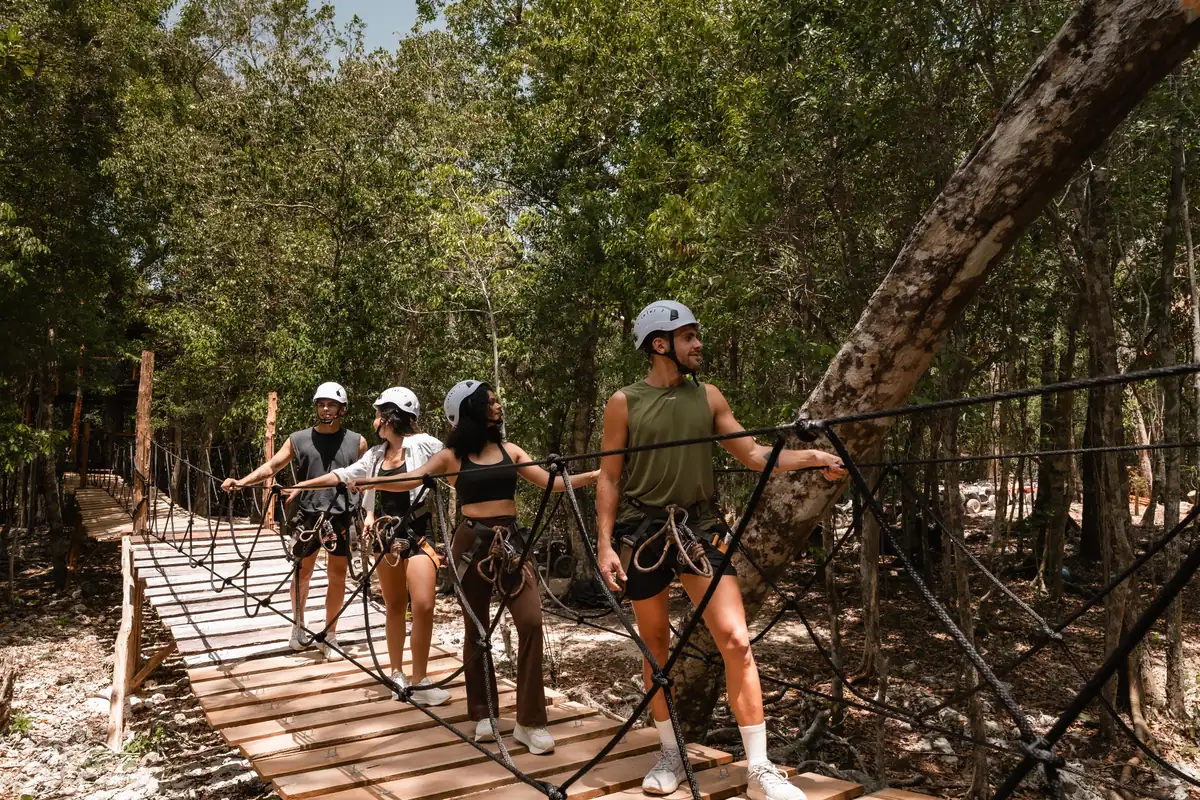
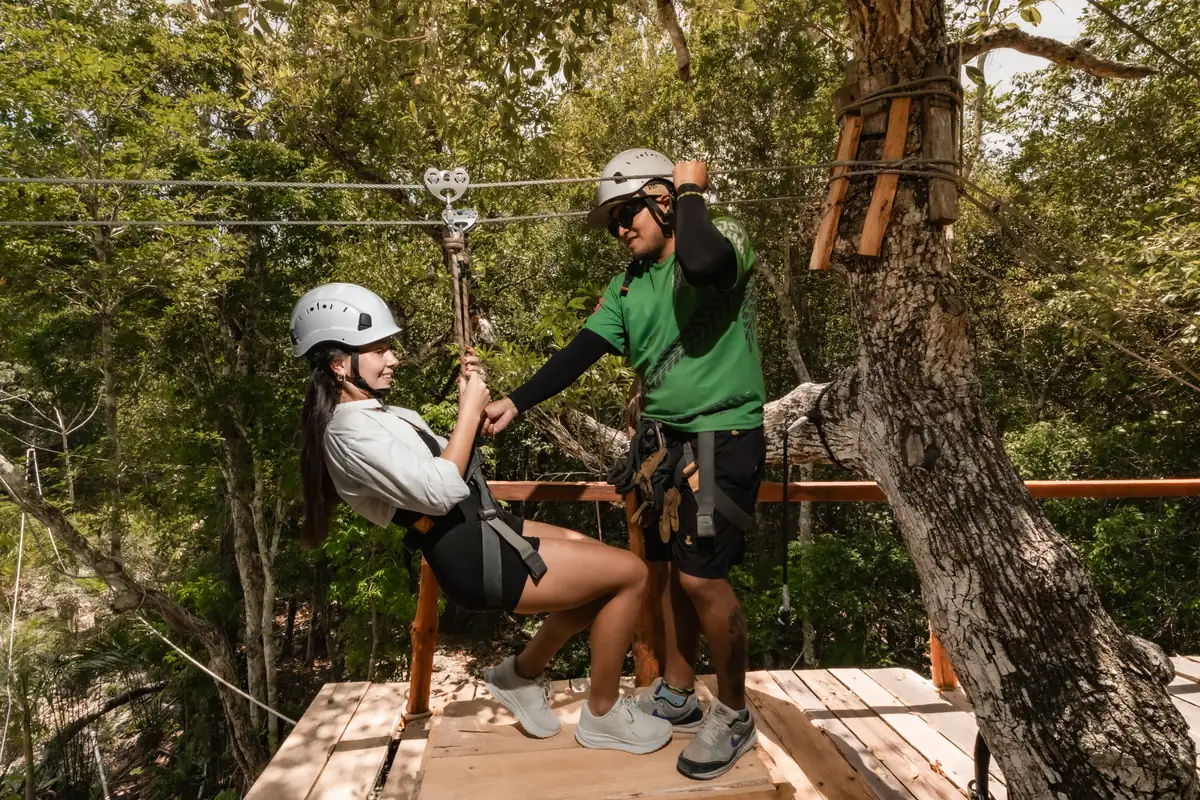
Many of the words above, like ts'ono'ot, ja' and k'iin, describe the landscape around the Ruta de los Cenotes. At Mayan Jungle Rush, near Puerto Morelos, our zipline circuit crosses right over a cenote, and several of our tours include a Maya snack. Feel free to ask your guide how to say a few words. Our all tours page has the options.
Frequently asked questions
How many people speak Maya today?
INEGI's 2025 intercensal survey counted about 779,000 Yucatec Maya speakers in Mexico, making it the country's second most spoken Indigenous language. Millions more people in Mexico and Central America speak other Mayan languages.
How do you say thank you in Maya?
The most common way in Yucatec Maya is Dios bo'otik. You may also see Ni'bóolal (or níib óolal) in some sources.
How do you say hello in Maya?
A common greeting is Ba'ax ka wa'alik?, and Bix a beel? means "how are you?" The usual reply is Ma'alob, "good."
What does the x sound like in Maya words?
Like English "sh." That is why xunáan kaab starts with a "sh" sound, and why bix sounds like "beesh."
Explore the jungle near Cancún
ATV, ziplines, a cenote swim and a tequila tasting on the Ruta de los Cenotes, with pickup from Cancún.
See All ToursSources
- Mexico in Numbers: How common are Indigenous languages in your state? – Mexico News Daily
- Disminución de la lengua maya en Yucatán – Diario de Yucatán
- Yucatec Maya Phrases – Na'atik Language & Culture Institute
- Useful phrases in Yucatec Maya – Omniglot
- Yucatec Maya language – Wikiwand
- Cenote etymology – Dictionary.com