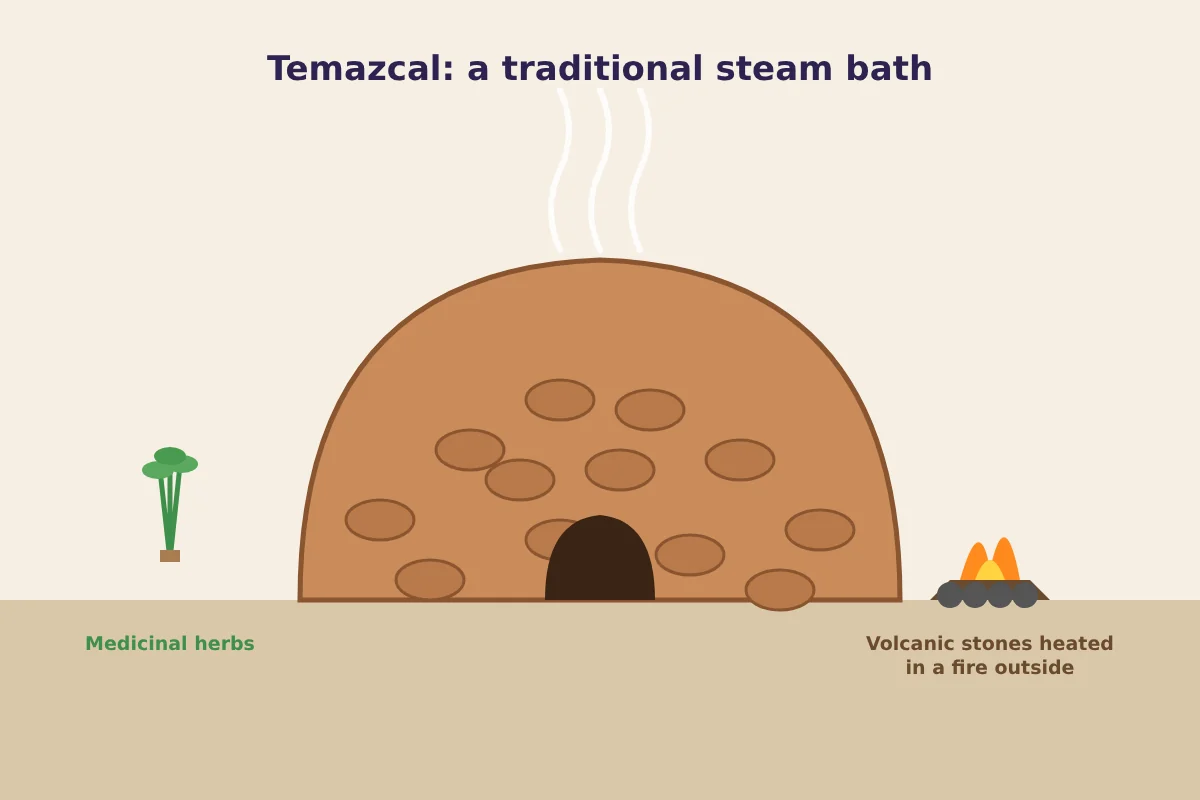
A temazcal is a traditional Mesoamerican steam bath: a small, usually dome-shaped room where water is poured over red-hot volcanic stones to fill the space with heat and steam. Today, a temazcal ceremony near Cancún typically lasts an hour or more, is led by a guide, and mixes the physical experience of intense heat with herbs, copal incense, intentions or prayers, and a cool-down at the end.
It is not a spa sauna with a theme. For many Indigenous communities in Mexico and Central America it has long been a place of healing, cleansing and childbirth care, and midwives still use it today. Below we explain where the tradition comes from, what usually happens inside, who should be careful, and how to choose an experience in the Cancún and Riviera Maya area that respects its roots.
Where does the word temazcal come from?
"Temazcal" comes from Nahuatl, the language of the Aztecs, which is still spoken in Mexico today. It is usually traced to temāzcalli, explained either as "house of heat" or as a combination of teme (to bathe) and calli (house). Through Spanish, the Nahuatl word became the general term used across Mexico, including in the Maya region.
The Maya had their own steam baths and their own words for them. A Maya dictionary compiled shortly after the Spanish Conquest records zumpul-ché, defined as a bath "for women after childbirth and other sick persons to cast out the cold that they have in their bodies." Yucatán Magazine gives pibnaoob as a Yucatec Maya term for the ancient sweat baths of the peninsula.
Did the ancient Maya use steam baths?
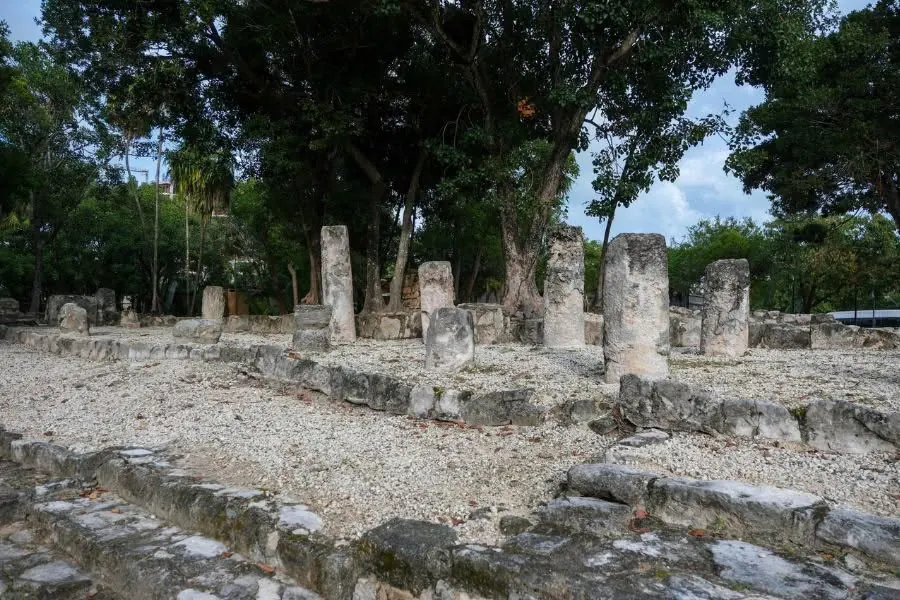
Yes. Archaeologists have identified sweat baths at several Maya sites. At Piedras Negras, in Guatemala, researchers from the Penn Museum excavated a well-preserved sweat bath known as Structure P-7 and identified several more ruined ones at the same city. Remains of sweat baths have also been found at Chichén Itzá, Palenque and other sites.
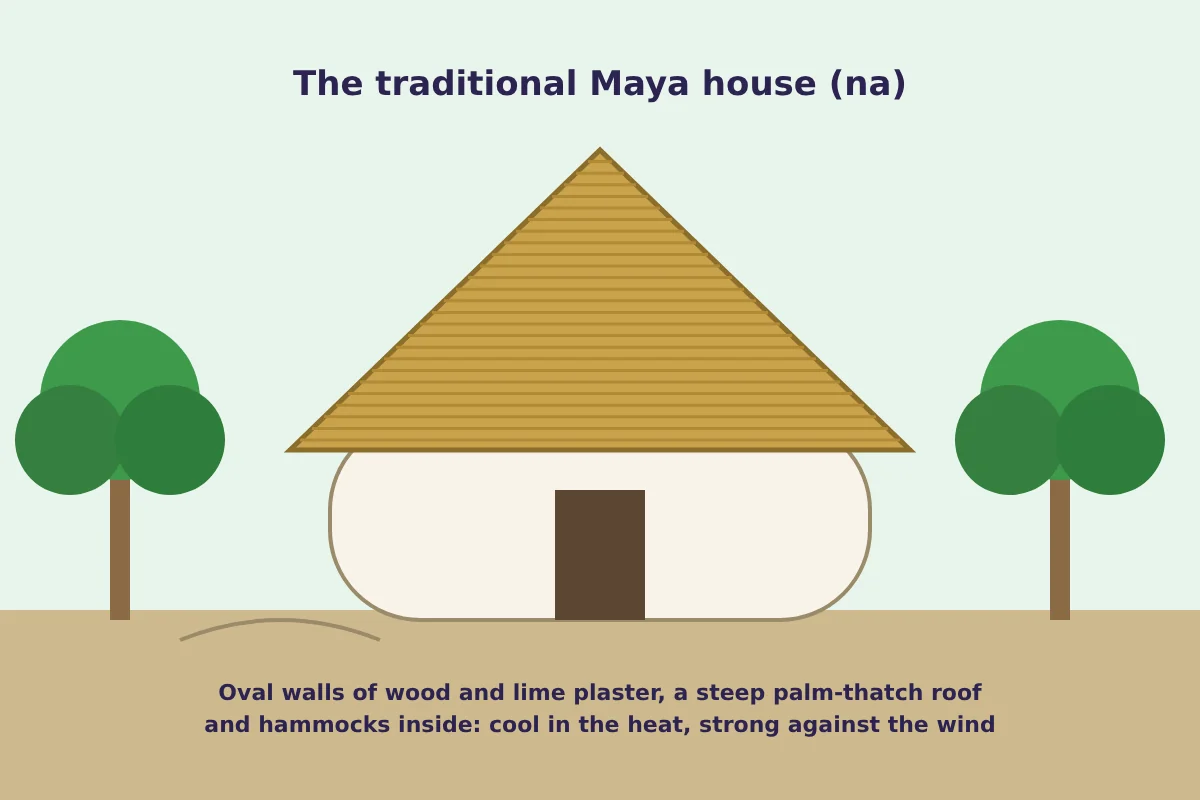
Ancient Maya sweat baths in Yucatán were built of limestone, sometimes had more than one chamber, and had small, low entrances that you had to stoop or crawl through. The fire was often inside the chamber. The round dome with a separate fire outside, common in tourist ceremonies today, follows the central Mexican (Nahua) design more closely.
Historically, sources describe the bath being used mainly by women before and after giving birth, and by people recovering from illness. It was also used to purify the body after hard physical effort.
What happens in a temazcal ceremony?
Practices vary a lot from one guide and one region to another, so treat this as a general picture, not a script.
- Preparation outside. The stones are heated in a fire until they glow. Participants are often cleansed with copal smoke, and some ceremonies begin with a short prayer, an intention, or a drink such as herbal tea or cacao.
- Entering the dome. You crawl or stoop through a low door and sit on the ground around a central pit. In some ceremonies everyone moves around the space in a set direction.
- The rounds or "doors." Many guides divide the ceremony into rounds, often called puertas (doors), frequently four, each linked to a cardinal direction or an element such as earth, water, air and fire. Between rounds, more hot stones (sometimes called abuelas, "grandmothers") are brought in and the door may open briefly for air. Some ceremonies use only two rounds.
- Steam and herbs. The guide pours water, often infused with herbs such as rosemary, basil, chamomile or eucalyptus, onto the stones. With the door closed, it gets completely dark and very hot. Some guides lead songs or prayers; others keep the space quiet.
- Cooling down. Afterward, participants rest and cool off gradually, often with a cool shower or a dip in water, and drink fluids or eat fresh fruit.
The person leading is often called a temazcalero or temazcalera. A good guide controls the heat, explains each stage, and watches everyone's comfort throughout.
Is a temazcal safe? Health cautions
A temazcal exposes your body to strong heat, and inside temperatures can push body temperature up significantly. Most healthy adults tolerate it well, but it is not for everyone. General medical guidance on saunas and heat baths applies here too:
- Pregnancy. Traditional midwives use temazcales in their own practice, but a tourist ceremony is a different setting. If you are pregnant, talk to your doctor before you go.
- Heart and blood pressure conditions. People with cardiovascular disease, a recent heart attack, or low or high blood pressure should get medical advice first. Moving between heat and cold can affect blood pressure.
- Alcohol. Do not drink alcohol before or during a temazcal. Alcohol in heat raises the risk of dehydration, fainting and heart rhythm problems.
- Dehydration and other conditions. Drink water before and after. If you have kidney problems, take medications that affect heat tolerance, or have any chronic condition, check with a doctor.
- Claustrophobia. The dome is small and fully dark. If that worries you, sit near the door and tell the guide.
You can leave at any time. A respectful guide will never pressure you to stay in, and staying near the ground keeps you in cooler air.
How do you choose a respectful temazcal near Cancún?
Temazcal ceremonies are offered across the Cancún and Riviera Maya area, from hotel spas to small eco-centers in the jungle and in Maya communities. Quality and respect vary, so ask before you book:
- Who leads it? Ask about the guide's training and background, and whether they are from the region or trained within a tradition.
- How many people? Smaller groups are calmer and let the guide watch everyone.
- What happens inside? A good provider explains the stages, how long it lasts and how hot it gets, and tells you that you can leave at any time.
- Do they ask about your health? A provider who asks about pregnancy, heart conditions and alcohol is taking safety seriously.
- Is it framed honestly? Be cautious of big promises about "detoxing" or curing illness. Also be wary of ceremonies that add substances you did not agree to.
Community-run experiences can be a good choice, because the money goes to local families. Our guide to visiting Maya communities responsibly explains how to find them and what to expect.
What should you bring to a temazcal?
- A swimsuit or light, loose clothing you do not mind getting soaked with sweat
- Two towels (one to sit on, one to dry off)
- Sandals that are easy to slip on and off
- A large bottle of water
- A change of clothes
- Optional: a light snack for afterward
Eat lightly a few hours before, not right before. Leave jewelry and electronics outside.
Can you combine a temazcal with a cenote day?
Yes, and it makes sense: water is central to both experiences. Many visitors spend the morning swimming in a jungle cenote and keep a relaxed afternoon or the next day for a temazcal. Avoid doing a temazcal when you are already tired, sunburned or dehydrated from a long day outdoors.
On the Ruta de los Cenotes near Puerto Morelos, our Cenote Tour gives adults about three hours at a jungle cenote with a Maya snack, and our combo tours add ziplines, ATVs or horseback riding to a cenote swim. Only biodegradable sunscreen is allowed in the cenote. If it is your first cenote, read how to prepare for your cenote swim, and if you are curious why the Maya saw cenotes as sacred, see our article on Chaac, the Maya rain god.
Frequently asked questions
How long does a temazcal ceremony last?
It varies by provider. Many ceremonies run from about one to two hours including preparation, the rounds inside and the cool-down; ask before you book.
Is a temazcal Maya or Aztec?
Both peoples used steam baths. The word "temazcal" comes from Nahuatl, the Aztec language, while the Maya had their own sweat baths and terms such as zumpul-ché, recorded in a colonial-era Maya dictionary.
What do you wear in a temazcal?
A swimsuit or light, loose clothing is standard in tourist ceremonies. Bring towels and a change of clothes.
Can I do a temazcal if I am pregnant or have high blood pressure?
Check with your doctor first. Intense heat can affect blood pressure and is a concern in pregnancy, and a responsible provider will ask about these conditions before you enter.
Explore the jungle near Cancún
ATV, ziplines, a cenote swim and a tequila tasting on the Ruta de los Cenotes, with pickup from Cancún.
See All Tours