Xibalbá is the name of the underworld in the Popol Vuh, the sacred book of the K'iche' Maya of highland Guatemala. It is usually translated as "place of fear" or "place of fright," and it was ruled by lords of death who tested anyone who entered. Across the Maya world, caves and still water were understood as ways into this underground realm. On the Yucatán Peninsula, where the landscape is full of both, cenotes became some of the most important sacred places of all.
That does not mean every cenote was seen as a scary hole to the land of the dead. For the Maya, the underworld was also tied to water, rain, ancestors and fertility. Here is what the sources actually tell us, what archaeologists have found, and how you can visit cenotes today in a way that respects the people for whom these places still matter.
What is Xibalbá?
In the Popol Vuh, Xibalbá is a court beneath the earth ruled by a council of death lords. The two most important are named One Death and Seven Death. Some of the lords could climb up into the world of the living to spread misery and disease.
The Yucatec Maya, whose descendants live around Cancún and across the peninsula today, had their own name for the underworld: Metnal. The details varied from region to region and changed over time, so it is best to think of Xibalbá as the K'iche' version of a widely shared Maya idea, not as a single fixed place.
The road to Xibalbá was dangerous. Travelers had to cross rivers, including rivers of blood and pus in some tellings, and pass through dark houses full of hazards.
What happens in the Popol Vuh?
The Popol Vuh was written down in the mid-1500s and was later copied and translated into Spanish by a priest in the early 1700s. It is one of the most important sources on Maya mythology.
The best-known section follows the Hero Twins, Hunahpú and Xbalanqué:
- The first defeat. Their father, Hun Hunahpú, and uncle were summoned to Xibalbá after the death lords were angered by their constant ballplaying. The lords tricked and killed them, and hung Hun Hunahpú's head in a tree.
- A miraculous birth. When a young woman reached toward the tree, the head spat into her hand, and she became pregnant with the twins.
- The trials. Years later the twins were summoned too. They survived a series of deadly houses, including the House of Knives, the House of Cold, the House of Jaguars, the House of Fire and the House of Bats, where a bat cut off Hunahpú's head. His brother restored it with cleverness and help from animals.
- The ballgame and the trick. The twins tied the death lords at the ballgame, then let themselves "die" in a stone oven and came back to amaze the lords with tricks of sacrifice and revival. The lords asked to be sacrificed and revived too. The twins did the first part and not the second.
- The outcome. Xibalbá was defeated and the fathers avenged. In some versions, the twins then become the sun and the moon.
It is a story of brains over brute power, and of life coming back from death. Notice how central the ballgame is. We explain the real sport in our post on pok ta pok, the Maya ballgame.
Why were caves and cenotes seen as portals?
According to the World History Encyclopedia, Xibalbá was entered through a cave or an area of still water. On the Yucatán Peninsula, a cenote is both at once: a hole in the rock that drops to dark, calm water.
Archaeologists studying Maya caves add several layers to this:
- Caves were the earth's womb. Researchers describe water-bearing caves being seen as the generative womb of the earth, linked to creation and fertility, not only to death.
- Caves were where rain came from. Rain gods such as Chaac were associated with caves and underground water. Our article on Chaac, the Maya rain god covers that link.
- Caves were the realm of ancestors. Rural Maya communities buried their dead in caves and rock shelters over many centuries.
- Caves shaped cities. Some archaeologists, notably James Brady, argue that Maya builders planned sites around natural and artificial caves. Others think that goes too far, so this is still debated.
The geology helps explain why cenotes fit so naturally into this worldview. There are almost no rivers on the peninsula, and nearly all fresh water lies underground. Read more in how cenotes were formed.
What have archaeologists found in cenotes and caves?
The most famous example is the Sacred Cenote at Chichén Itzá, whose name is often translated as "mouth of the well of the Itzá." In the early 1900s, the American Edward H. Thompson dredged the cenote and recovered gold, jade, pottery, copal incense and human remains. Most of that material went to Harvard's Peabody Museum, which still holds nearly 30,000 objects from the cenote. Some pieces of jade and gold have since been returned to Mexico.
Later work, including a 1961 project by Mexico's National Institute of Anthropology and History (INAH) with divers from the exploration club CEDAM, recovered more offerings. Jade was the most common material. Since jade, gold and copper are not found naturally in Yucatán, many objects had to come from far away, which shows how important the cenote was as a pilgrimage site.
Spanish accounts from the 1500s, including Bishop Diego de Landa's, say people were sometimes thrown into the cenote as offerings during droughts. Human remains confirm that sacrifice happened, but archaeologists caution that these sources do not tell us how often. Most of what went into the water was objects, not people.
Near Chichén Itzá, the Balankanché cave (also spelled Balamcanché) offers another window. INAH describes chambers filled with incense burners decorated with images of the rain god, miniature grinding stones and small vessels, plus a central column of rock compared to the sacred ceiba tree. In one chamber, a clear pool of water was likely considered zuhuy ha, "virgin water," used in ritual.
Do Maya people still consider cenotes sacred?
Yes, in many communities. Maya religion did not disappear with the Spanish conquest. It blended with Catholicism and continues in rain ceremonies, offerings and prayers led by h-men (traditional ritual specialists). Water from cenotes and caves is still used in some ceremonies in Yucatán.
The Maya are a living people. Around 780,000 people speak Yucatec Maya in Mexico, according to INEGI's 2025 intercensal survey, and millions more speak other Mayan languages in Mexico and Central America. Our guide to Yucatec Maya words and phrases is a good starting point if you want to connect with that culture today.
How to visit cenotes respectfully
You do not need to treat a swim like a ritual, but a few habits go a long way:
- Follow the site's rules. Some cenotes are archaeological zones where swimming is banned, such as the Sacred Cenote at Chichén Itzá.
- Leave offerings alone. If you see flowers, candles, crosses or small objects near water, do not touch or move them.
- Protect the water. Shower first, use only biodegradable sunscreen, and do not touch formations. Our cenote prep guide has a full checklist.
- Keep the noise down. Sound carries in rock basins, and for many local families these are meaningful places, not just swimming holes.
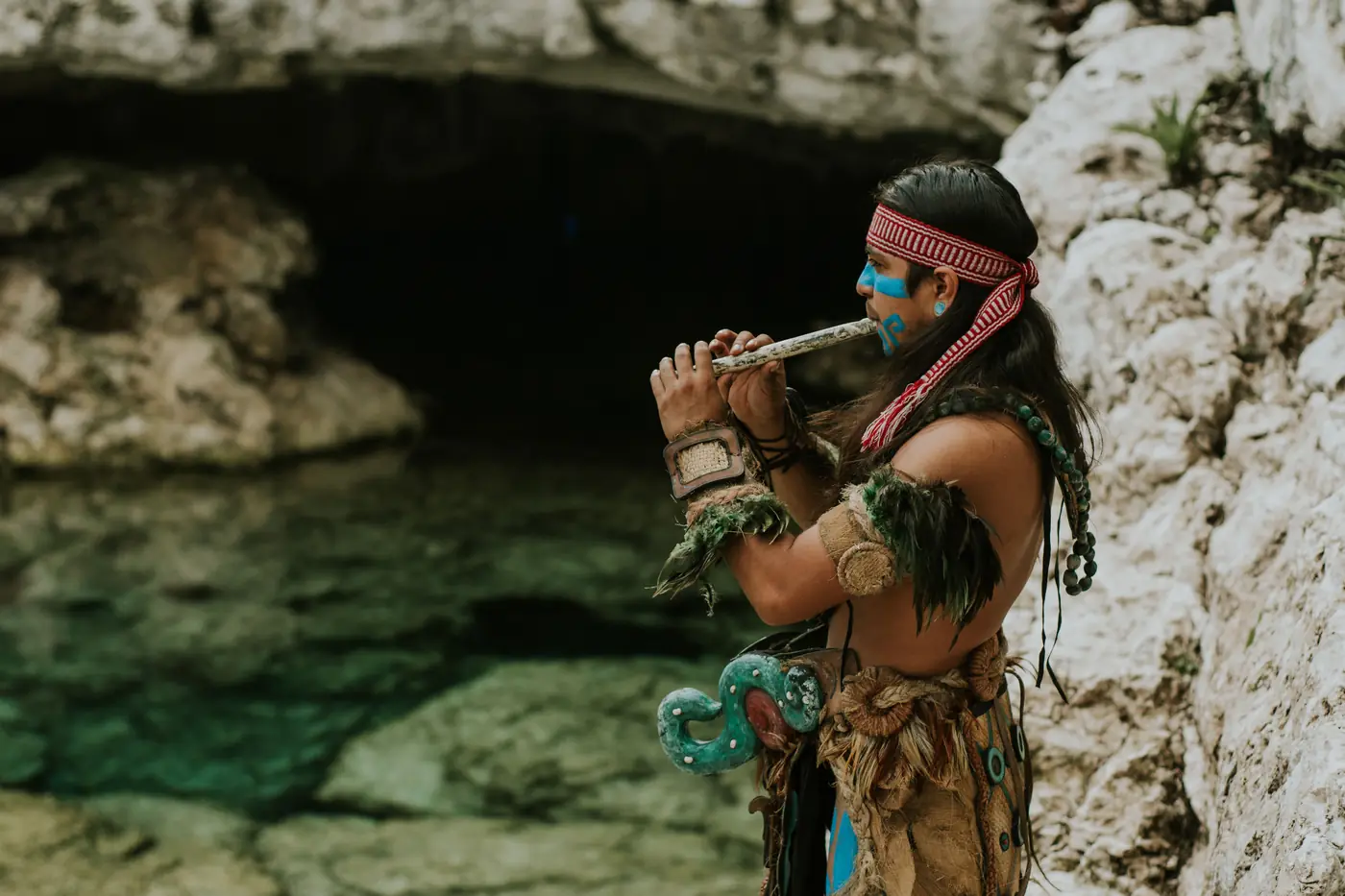
- Be skeptical of staged "ancient rituals." Some ceremonies offered to tourists are performance, not tradition. That is not necessarily bad, but know what you are watching.
Visit a jungle cenote near Cancún
Mayan Jungle Rush is at km 18.5 of the Ruta de los Cenotes near Puerto Morelos. Our adults-only Cenote Tour gives you about three hours at a jungle cenote with a Maya snack, and your guide is happy to answer questions about the cenote and the area.
Frequently asked questions
What does Xibalbá mean?
It is usually translated as "place of fear" or "place of fright." It is the K'iche' Maya name for the underworld in the Popol Vuh.
Is there a real cenote called Xibalbá?
Not in the traditional sense. In Maya belief there was no single entrance; caves and still water in general were seen as ways into the underworld. Any modern site using the name is borrowing it.
Were people sacrificed in cenotes?
At Chichén Itzá's Sacred Cenote, human remains and Spanish colonial accounts show that it happened, but most offerings were objects like jade, gold, pottery and copal. Archaeologists say the sources do not show how often sacrifices took place.
What is the Popol Vuh?
It is the sacred book of the K'iche' Maya of Guatemala, written down in the mid-1500s. It tells the creation of the world and of people from maize, and the adventures of the Hero Twins.
Swim in a jungle cenote
Spend 3 hours at our cenote on the Ruta de los Cenotes, with pickup from Cancún.
See the Cenote Tour