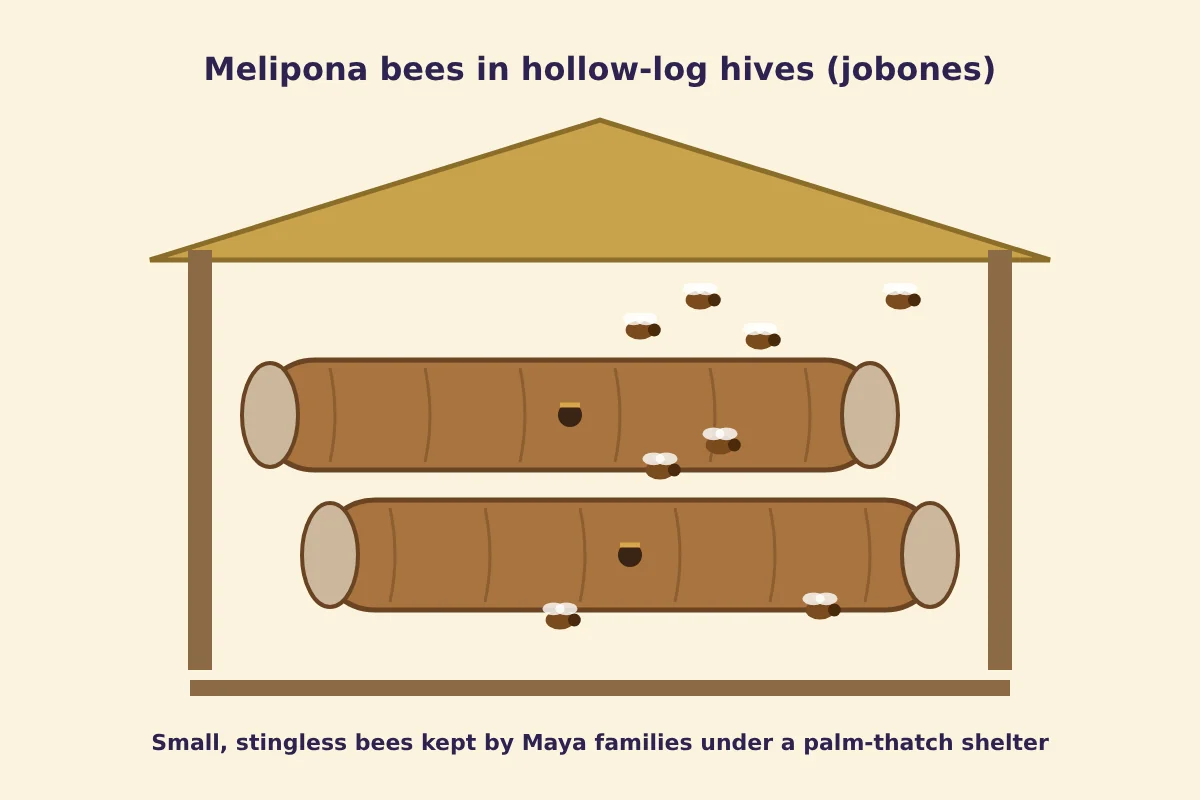
The Melipona bee (Melipona beecheii) is a stingless bee of the Yucatán Peninsula and the bee the Maya have kept for honey since long before Europeans arrived. In Yucatec Maya it is called xunáan kaab, usually translated as "royal lady bee." Traditionally it lives in jobones, hollow logs sealed at both ends, and its honey has been used in food, medicine and ceremonies for many centuries.
Today the tradition is fragile. Melipona colonies make only a small amount of honey, many keepers have switched to the more productive European honeybee, and forests that feed the bees have shrunk. Here is what makes this bee special, where meliponiculture (stingless beekeeping) stands today, and how to make sure the honey you buy is the real thing.
What is the Melipona bee?
Melipona beecheii belongs to the meliponines, the stingless bees of the tropics. Mexico has around 46 species of stingless bees, and Quintana Roo alone is home to 16 of them, according to INAH, Mexico's national institute of anthropology and history.
Of the hundreds of stingless bee species worldwide, M. beecheii stands out because Maya keepers routinely propagated it, dividing colonies to start new ones. It does not sting, many Maya families have kept it in their home gardens, and instead of honeycombs it stores honey and pollen in small wax pots inside the nest.
The Maya name tells you how it was regarded. Researchers at the Smithsonian Tropical Research Institute translate xunáan kaab literally as "royal lady," a respectful title for a bee that was considered sacred.
How long have the Maya kept stingless bees?
For a very long time. Archaeologists working at Cerro Maya, in northern Belize, have interpreted worked limestone discs from the Late Formative period (about 200 BC to AD 200) as likely hive covers, which would put Maya stingless beekeeping at least 2,000 years in the past. The authors present this as a hypothesis rather than proof.
Closer to Cancún, the evidence is even easier to picture:
- A bee god in local ruins. Ah Muzen Cab, a deity linked to bees and stingless beekeeping, appears in sculpture at Tulum, Cobá and Tankah, all in Quintana Roo.
- Stone lids on the Maya Train route. During archaeological rescue work for the Tren Maya between Bacalar and Limones, INAH archaeologists found stone lids believed to date to the Postclassic period (950–1539) and used to seal log hives. Lids like these are still used today.
- A bee house near Tulum. In 2026, INAH released details of a limestone structure near Aktun Chen, about 16 km north of Tulum, interpreted as a ná'ajil kab (bee house) that held rows of log hives, along with 40 limestone and coral discs likely used as lids. It likely dates to the Late Postclassic period.
Bee culture also appears in the Madrid Codex, one of the few Maya books that survived the colonial period, and honey and wax were paid as tribute both before and after the Spanish arrived. You can visit Tulum and Cobá yourself; our guide to Maya ruins near Cancún covers the closest ones.
How does a jobón hive work?
A jobón is a section of hollow log with the bee colony living inside. The ends are closed with round lids, often of stone like the ones archaeologists find, and sealed. Keepers traditionally keep their logs close to home, much as the ancient bee house near Tulum held its hives in rows. To harvest, the keeper opens the hive and takes some of the honey pots, leaving the colony enough to survive.
Melipona colonies produce very little: estimates range from under one liter to about two liters of honey per hive per year, compared with dozens of liters from a European honeybee hive. Harvests traditionally take place only twice a year, and in some places they are accompanied by ceremonies with prayers and offerings.
Many modern keepers now use wooden boxes. In one 2025 study of keepers in northwestern Yucatán, most hives were modern boxes rather than logs, although the jobón is still used and still sealed in the traditional way.
Why is the Melipona bee declining?
The decline has been documented for decades. In a study published in 2005, researchers from El Colegio de la Frontera Sur in Quintana Roo and the Smithsonian estimated that the number of Melipona hives in the Yucatán communities they surveyed fell from more than 1,000 in the early 1980s to about 400 in 1990 and only about 90 in 2004.
The main causes researchers point to:
- Competition from honeybees. European and Africanized honeybees (Apis mellifera) produce far more honey, so many families switched.
- Habitat loss. Deforestation, monoculture farming and urban growth reduce the flowers native bees depend on.
- Pesticides and storms. Agricultural chemicals and hurricanes have killed or weakened colonies.
- Lost knowledge. Many keepers are older, and when they stop, their colonies and their know-how can disappear.
- Over-harvesting. Taking too much honey can kill a colony.
There are also efforts to keep the tradition alive. Community projects, including groups of Maya women beekeepers, and foundations across the peninsula now offer courses and workshops, and many keepers raise several stingless species specifically for conservation.
What is Melipona honey used for?
Melipona honey is noticeably thinner than ordinary honey because it contains more water. Its reputation comes mainly from tradition.
In Maya traditional medicine it has long been used for the eyes, ears and skin, and midwives combine it with herbs in warm drinks for pregnant women. It is also offered in ceremonies alongside drinks such as balché. Today it also turns up in products such as cosmetics and eye drops sold in some natural-products stores.
These are traditional uses, not proven treatments. If you have a health condition, talk to a doctor rather than relying on honey, and never put anything in your eyes without medical advice.
Where can you see Melipona bees in the Yucatán Peninsula?
Several community and tourism projects let visitors see a meliponario (stingless bee yard). A few examples to research before your trip:
- Maní, Yucatán: the state tourism board lists a Melipona tour led by Maya women from the community, with a visit to a meliponario and a honey tasting.
- X-cabil, Quintana Roo: a Maya community in the municipality of José María Morelos whose meliponario is part of the Maya Ka'an community tourism circuits.
- Xel-Há park, Riviera Maya: the park has a meliponary in its nursery area that visitors can walk through.
Programs, schedules and booking details change, so check directly before you go. Even if you don't visit a meliponario, the forests of northern Quintana Roo, including the jungle along the Ruta de los Cenotes where our jungle tours run, are part of the landscape these native bees depend on. If you visit a community, our guide to visiting Maya communities responsibly has useful tips.
How do you buy real Melipona honey?
Because Melipona honey is scarce and much more expensive than regular honey, it pays to buy carefully. To get the real thing:
- Buy from the source. Look for cooperatives, community projects or named producers, ideally where you can see the bees.
- Ask which bee made it. Several stingless bees make honey. The traditional xunáan kaab honey of the Yucatán comes from M. beecheii; honey from other species can be good too, but it is not the same product.
- Expect small bottles. With one or two liters per hive per year, real Melipona honey tends to be sold in small quantities.
- Check the texture. It should be noticeably runnier than ordinary honey.
- Be wary of bargains. A big jar at a low price is unlikely to be pure Melipona honey.
A small bottle makes a meaningful gift, and buying directly supports the keepers who are keeping this tradition alive. For more ideas, see our guide to authentic souvenirs from Cancún. If you want to taste honey in a local drink, read about Xtabentún, the Yucatán's honey and anise liqueur.
Frequently asked questions
Do Melipona bees sting?
No. Melipona bees are stingless. Still, let the keeper handle the hives and follow their instructions during a visit.
What does xunáan kaab mean?
It is the Yucatec Maya name for Melipona beecheii, usually translated as "royal lady bee" or "lady bee."
Why is Melipona honey so expensive?
Each colony produces only about one to two liters a year, compared with dozens of liters from a honeybee hive, and keeping the bees takes a lot of care.
Is the Melipona bee endangered?
Traditional Melipona keeping has declined sharply, and researchers have documented big drops in managed colonies in the Yucatán. Habitat loss, pesticides and competition from honeybees are the main threats.
Explore the jungle near Cancún
ATV, ziplines, a cenote swim and a tequila tasting on the Ruta de los Cenotes, with pickup from Cancún.
See All ToursSources
- Maya stingless bee husbandry in decline (ScienceDaily / Smithsonian Tropical Research Institute)
- Boletín 270: abejas meliponas en Quintana Roo (INAH)
- The origins of Maya stingless beekeeping (Journal of Ethnobiology, via FAO AGRIS)
- Meliponicultura del noroeste de Yucatán (Estudios de Cultura Maya, SciELO)
- Maya apiary found near Tulum (Mexico News Daily)
- Physicochemical properties of pot-honey from Melipona beecheii (Ingeniería e Investigación, via DOAJ)