The Maya ballgame was a team sport played with a heavy, solid rubber ball that players kept in motion mostly with their hips, on a long, narrow court flanked by stone walls. It was part of a much older Mesoamerican tradition: the oldest known ballcourt, at Paso de la Amada on Mexico's Pacific coast, dates to around 1400 BCE. It was a game, a public spectacle and, at times, a religious ritual.
You will often hear it called pok ta pok. That name is modern. According to scholarly summaries, it comes from a 1932 article by archaeologist Frans Blom, who adapted it from the Yucatec Maya word pokolpok. In Classic Maya inscriptions the game was called pitz, and the Aztecs called their version ōllamaliztli. Today, a revived version is played in tournaments across Mexico and Central America, and you can see the most famous ancient court on a day trip from Cancún.
How was the Maya ballgame played?
The honest answer is that nobody knows the ancient rules in detail. What researchers have pieced together comes from three places: the courts themselves, carved and painted images, and Spanish accounts of the Aztec game written in the 1500s.
Here is what is generally accepted:
- Hips, not hands. In the most common reconstruction, players struck the ball with their hips. Some regional versions used forearms, and a few may have used sticks or bats.
- Two teams on a long alley. Courts were long and narrow, with walls on the long sides that the ball could bounce off.
- Protective gear. Images show players wearing thick belts or yokes around the waist, and sometimes knee and arm padding.
- Keeping the ball alive. Accounts based on the Aztec game and on modern survivals suggest points were lost when the ball bounced too many times or went out of play.
The rules almost certainly changed over the roughly 3,000 years the game was played and from one region to another. Be wary of any source that gives you a precise rulebook.
How heavy was the rubber ball?
Mesoamerican peoples were working with rubber thousands of years before Europeans encountered it. Most balls were made from the latex of the Castilla elastica tree, mixed with juice from a morning glory vine (Ipomoea alba) to make the material bouncy and durable. The oldest known rubber balls in the world were found at El Manatí, an Olmec site in Veracruz, and date to around 1700–1600 BCE.
Ancient balls varied in size, and their exact weight in play is not known with certainty. Estimates range from about 1.4 kg to around 4 kg (roughly 3 to 9 lb). Modern players in Yucatán use a ball of about 3 kg. Either way, this was a ball that could bruise or injure, which explains the padding.
What were the stone rings for?
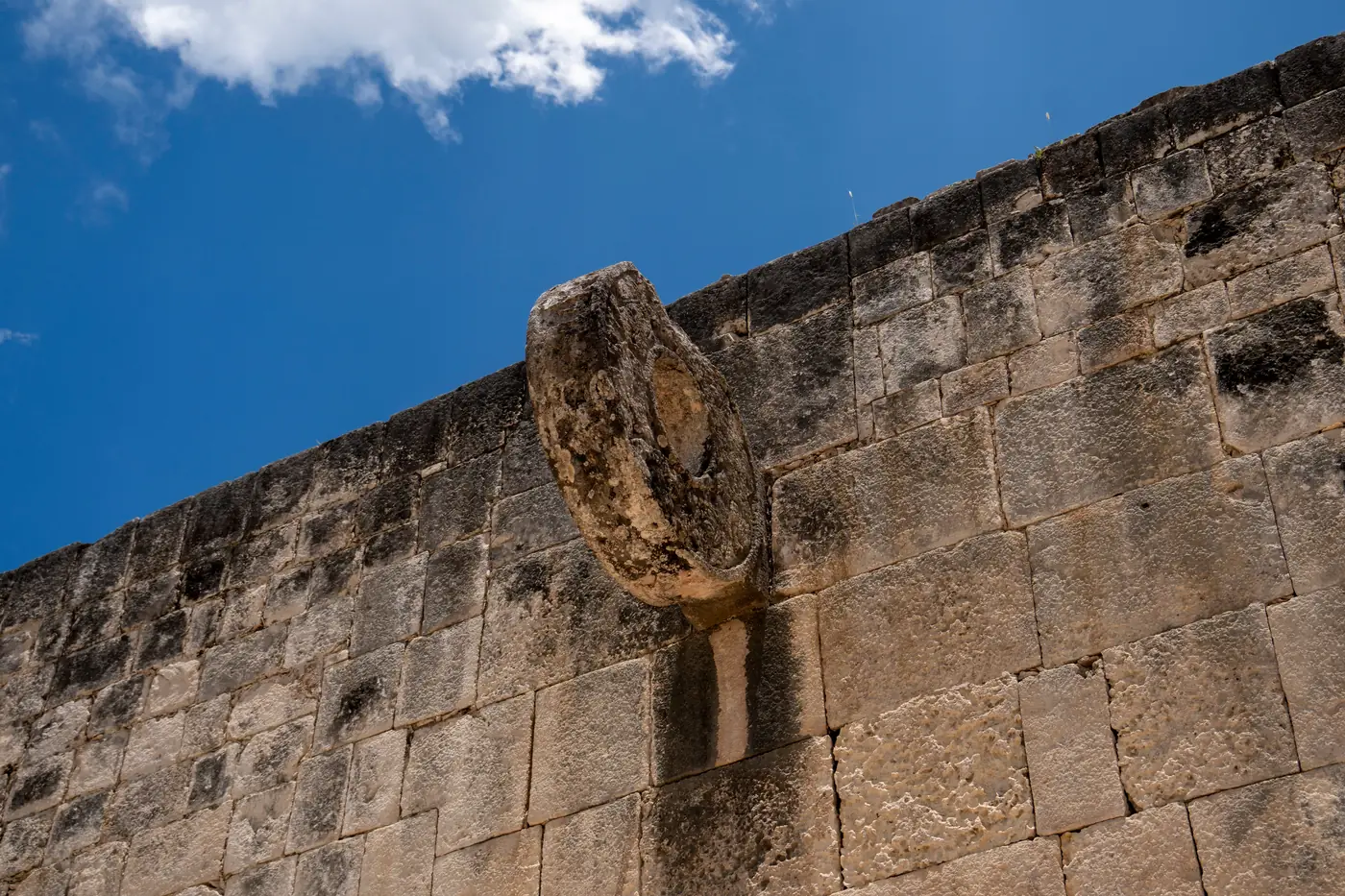
The vertical stone rings mounted high on court walls are the most photographed part of the game, but they were a fairly late addition. Rings appeared on Maya court walls mainly in the Postclassic period, the centuries just before the Spanish arrived, so many older courts never had them.
Exactly how the rings counted in the ancient game is not known. What is clear is that sending a solid rubber ball through a ring set high on a wall, without using your hands, would have been extremely difficult. That is one reason the modern revived game treats the ring as a special, high-value shot.
What makes the Great Ball Court at Chichén Itzá special?
The Great Ball Court at Chichén Itzá, in Yucatán state, is the largest known ballcourt in Mesoamerica. Its playing field measures about 96.5 by 30 meters (317 by 98 feet), and the whole complex is much larger. Two stone rings carved with intertwined serpents sit high on the long walls, and temples overlook the court, including the Upper Temple of the Jaguars on the east wall.
Its size is so unusual that some researchers think it may have been mainly ceremonial rather than a court for regular games.
Along the base of the walls run carved panels showing two teams of players. In the best-known scene, the winner holds a blade and the head of a defeated player, and the blood spurting from the kneeling figure's neck is shown as serpents, with a flowering plant growing from the body. Scenes like this are why the ballgame is linked with sacrifice. Researchers note that this link appears relatively late and was not part of every game. Many matches were sport, politics and festival, not life-or-death contests.
For a closer look at the site, see our guide to day trips from Cancún.
How is the ballgame connected to the Popol Vuh?
The Popol Vuh, the K'iche' Maya book of creation from highland Guatemala, puts the ballgame at the center of its story. Two brothers, Hun Hunahpu and Vucub Hunahpu, play ball so loudly that they disturb the lords of Xibalba, the underworld. The lords summon them, defeat them and kill them, and Hun Hunahpu's head is hung in a tree.
That head later fathers the Hero Twins, Hunahpu and Xbalanque. The twins grow up, go down to Xibalba, survive a series of deadly tests and beat the underworld lords at their own game. The story turns the ballcourt into a place where life, death and rebirth meet.
If you want to know more about Xibalba and why many cenotes were seen as entrances to it, read our article on Xibalba and the Maya underworld.
Is the Maya ballgame still played today?
Yes, in two ways. In parts of Sinaloa, in northwestern Mexico, a descendant of the ancient game called ulama has survived in some communities.
In the Maya region, a modern revival has grown into an international sport. A Yucatán association founded in 2006 worked to revive the game, which players often call pok ta pok or pelota maya. According to Mexico News Daily, the first world championship was held at Chichén Itzá in 2015, followed by tournaments in Guatemala (2017), El Salvador (2019) and Mérida (2021). Belize won the 2017, 2019 and 2021 titles, and a team of players from Yucatán won for Mexico at the championship held in Belize in December 2023. In 2025 the Yucatán-based association announced it had become an international federation, with members from several countries in the Americas.
In the modern version, teams send the ball across the court with their hips, diving and leaping to keep it alive. Points are scored by getting the ball past the opponents' end line, and judges at the side of the court keep score. A ring hangs at the center, and putting the ball through it is worth more points; in finals, it can end the game outright. Both men and women play. Tournaments within Mexico have brought together teams from Yucatán, Campeche, Chiapas and Quintana Roo.
Where can you see the ballgame near Cancún?
- Ancient courts. Chichén Itzá's Great Ball Court is the essential one. Cobá, in Quintana Roo, also has a ballcourt with a stone ring on its wall.
- Shows. Some theme parks in the Riviera Maya, such as Xcaret, include ballgame exhibitions in their programs. These are dramatized performances, so enjoy them as theater rather than a historical reconstruction.
- Mérida. The city has hosted regular public demonstrations and is the center of the modern revival. Schedules change, so check locally before you go.
Before you go to any archaeological site, check opening details with INAH, Mexico's National Institute of Anthropology and History. For other ways to explore Maya history close to the Hotel Zone, see our guide to the Maya ruins inside Cancún, and to understand the dates carved on ballcourt monuments, read the Maya calendar explained.
Pair history with the jungle
If your trip leaves room for one half-day outside the city, the jungle along the Ruta de los Cenotes near Puerto Morelos gives you a feel for the landscape these cities grew up in. Our tours combine ziplines, ATVs or horseback riding with a cenote swim and a Maya snack, with hotel pickup from Cancún and Puerto Morelos. You can see all options on our tours page.
Frequently asked questions
What does pok ta pok mean?
It is a modern name, popularized by archaeologist Frans Blom in 1932 and adapted from the Yucatec Maya word pokolpok. In Classic Maya inscriptions the game was called pitz.
Did the losers of the Maya ballgame get sacrificed?
Sometimes, but not as a rule. Carvings like those at Chichén Itzá show sacrifice linked to the game, but researchers note this association appears relatively late and that many games were sport, politics or festival.
Did players have to get the ball through the stone ring?
Not necessarily. Rings were a later addition and many older courts had none. How they counted in ancient scoring is unknown; in the modern revived game, the ring is a rare, high-value shot.
Can I see the Maya ballgame played in Cancún?
You can see exhibitions at some Riviera Maya theme parks, and modern pelota maya tournaments are held in the region. The best ancient court to visit is the Great Ball Court at Chichén Itzá.
Explore the jungle near Cancún
ATV, ziplines, a cenote swim and a tequila tasting on the Ruta de los Cenotes, with pickup from Cancún.
See All ToursSources
- Mesoamerican ballgame – Wikipedia
- Rubbing from the Great Ballcourt at Chichén Itzá – Fine Arts Museums of San Francisco
- Pelota Maya's World Cup blends indigenous pride with artful gameplay – Mexico News Daily
- Ancient ballgame links its modern Maya players to a silenced culture – Mexico News Daily
- Yucatecos se convierten en campeones del mundo en el juego de pelota maya – Por Esto
- Mayan ball game World Cup kicks off in Mérida – Yucatán Magazine