Yes, there are Maya ruins inside Cancún itself, and you can reach all of them in a short bus or taxi ride. The three sites open to visitors are El Rey and San Miguelito, both in the Hotel Zone, and El Meco, just north of downtown near the Isla Mujeres ferries. San Miguelito sits on the grounds of the Museo Maya de Cancún, the city's main archaeology museum.
These were not great capitals like Chichén Itzá. They were coastal towns of fishermen, traders and sailors, and most of what you see dates to the Late Postclassic period, the few centuries before the Spanish arrived in the early 1500s. That is exactly what makes them interesting: they show how the Maya lived on this same stretch of Caribbean coast long before the resorts. Below you'll find the history of each site, what to look for, how long to stay and how to get there.
El Rey: Maya ruins in the middle of the Hotel Zone
Where: Kilometer 18 of Boulevard Kukulcán, in the Hotel Zone.
El Rey ("The King") gets its name from a carved stone head of a figure interpreted as a noble, found at the site. INAH's site description links the "Cabeza de El Rey" (the King's Head), documented in a 1909 photograph, to the collection of the Museo Maya de Cancún, so ask about it when you visit the museum. Because no hieroglyphic inscriptions have been found here, the settlement's original Maya name is unknown.
According to INAH (Mexico's National Institute of Anthropology and History), fishermen were already building wood-and-palm houses here around the year 300. The town grew most between about 1300 and 1550. After the Spanish arrived, its residents moved inland, and the island that is now the Hotel Zone was largely uninhabited until the early 20th century.
What you'll see at El Rey
- A main north–south avenue lined with residential buildings raised on platforms
- Two small plazas
- Small square altars set in the middle of the street
- Traces of mural paintings depicting deities on some structures
INAH notes that El Rey's northern platforms line up with the pyramid at San Miguelito, and that the two sites may have been parts of a single settlement. The site reopened in 2025 after a round of maintenance and restoration, with new signs and cleaned-up paths.
You will almost certainly meet iguanas here. They are commonly seen sunning themselves on the stones and along the trails. Enjoy them from a distance and don't feed them.
How long: INAH suggests 30 to 50 minutes.
San Miguelito and the Museo Maya de Cancún
Where: Around kilometer 16.5 of Boulevard Kukulcán, in the Hotel Zone. You enter San Miguelito through the museum.
The Museo Maya de Cancún
The museum opened in November 2012. It was designed by architect Alberto García Lascurain and displays around 350 archaeological pieces in three halls: two permanent galleries and one for temporary exhibitions. The collection includes pieces that had never been shown before and finds from recent excavations. It is air-conditioned and indoors, which makes it one of the best options in our list of rainy-day activities in Cancún.
The San Miguelito archaeological zone
From the museum's lower level, a shaded trail leads through original jungle vegetation to San Miguelito. INAH describes it as a Late Postclassic port and ceremonial center, with palaces dating to the 13th and 14th centuries. Its architecture follows the East Coast style, the regional style best known from Tulum, and the town lived largely from fishing and maritime trade.
The site is made up of at least four groups of structures. Highlights include:
- The pyramid, around 8 meters (26 feet) tall, whose base was remodeled at least three times
- Palaces where large families lived in the final years before the Spanish conquest
- The Dragons group (Conjunto de los Dragones), with four palace buildings and the remains of a mural showing an aquatic scene with fish and what appears to be a turtle
- Remains of houses whose stone platforms once supported timber and palm buildings
Archaeologists have recorded almost 50 burials at San Miguelito, along with objects of obsidian, quartz, ceramic, coral and conch shell.
How long: INAH suggests one to two hours for San Miguelito. Add time for the museum; together, plan on at least two to three hours. One ticket has traditionally covered both the museum and the site.
El Meco: the port that faced Isla Mujeres
Where: North of downtown Cancún, on the road from Puerto Juárez to Punta Sam, close to the ferry terminals for Isla Mujeres.
El Meco is the least visited of the three, and in our view the most rewarding. Its name has nothing to do with the ancient city: according to INAH, "El Meco" was the nickname of a 19th-century local resident.
The site may have started as a small fishing settlement around the 3rd century, was later abandoned, and was reoccupied in the 11th century. In the Postclassic period it became a busy port that controlled access to Isla Mujeres across the water, and its religious life may have been linked to rituals on the island.
What you'll see at El Meco
- El Castillo, the tallest building at the site, which dominates the main plaza; its staircase ends in two large serpent heads that recall Chichén Itzá
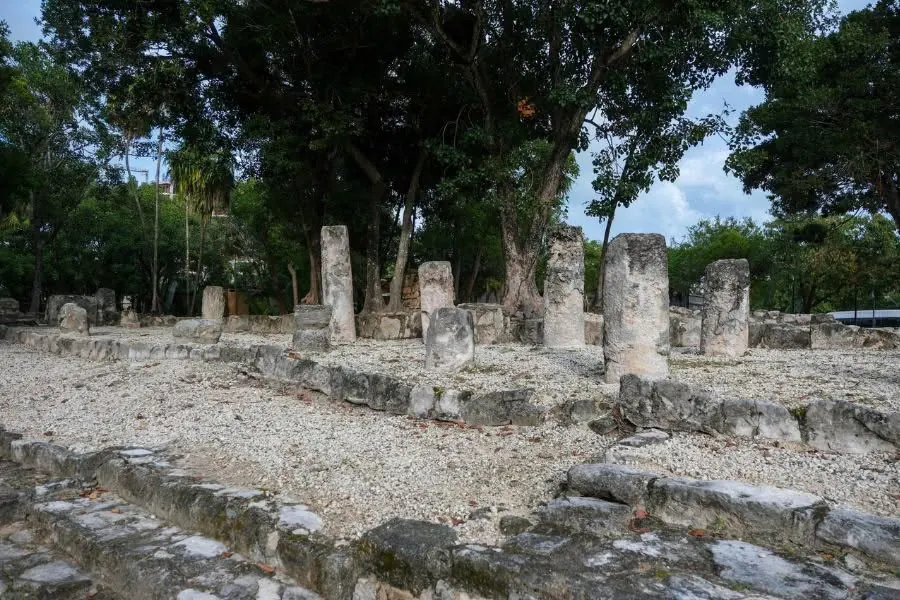
- Buildings with columns that once held up flat roofs, probably used for administration
- A small central shrine in the plaza, used for offerings during ceremonies
- A temple on the north side of the plaza with a fig tree growing out of it
El Meco reopened in December 2024 after a major improvement project that added new visitor facilities and interpretive trails. INAH also reports that the site's connection to the coastline, cut in the 1970s by road construction, has been restored.
How long: We'd allow about an hour on site, plus travel time.
How do you get to the Maya ruins in Cancún?
- By bus: Red city buses marked "Hoteles" or "Zona Hotelera" (routes such as the R-1) run up and down Boulevard Kukulcán with stops every few blocks. Ask the driver to let you off at "Ruinas El Rey" or "Museo Maya." The R-1 also runs north to the Isla Mujeres ferry terminal at Puerto Juárez, from where El Meco is a short taxi ride.
- By taxi: Taxis are easy to find at hotels and on the boulevard. Agree on the fare before you get in, and expect a higher rate from hotel taxi stands and at night.
- Walking between sites: El Rey (km 18) and the Museo Maya (km 16.5) are close enough to combine in one outing; a short bus ride connects them if you prefer not to walk along the boulevard in the heat.
Fees, opening days and hours change, and sites sometimes close for maintenance. Check INAH's official listing before you go.
Tips for visiting
- Go early or late. These sites have little shade and the coastal sun is strong, especially at El Rey.
- Bring water, a hat and insect repellent. Mosquitoes can be active in the vegetation, particularly after rain.
- Wear comfortable shoes. Paths are uneven in places.
- Stay off the structures. Respect the signs and roped areas; these are protected monuments.
- Read first. A little background goes a long way. Our history of Cancún covers what happened between the Maya ports and the modern resort, and our guide to the Maya calendar helps you read the dates you'll see on museum pieces.
How to fit the ruins into your Cancún trip
The Hotel Zone sites are easy half-day plans. A good combination is the Museo Maya and San Miguelito in the morning, El Rey afterward, then lunch and the beach. El Meco pairs naturally with a ferry trip to Isla Mujeres. For more ideas around town, see our list of the best things to do in Cancún.
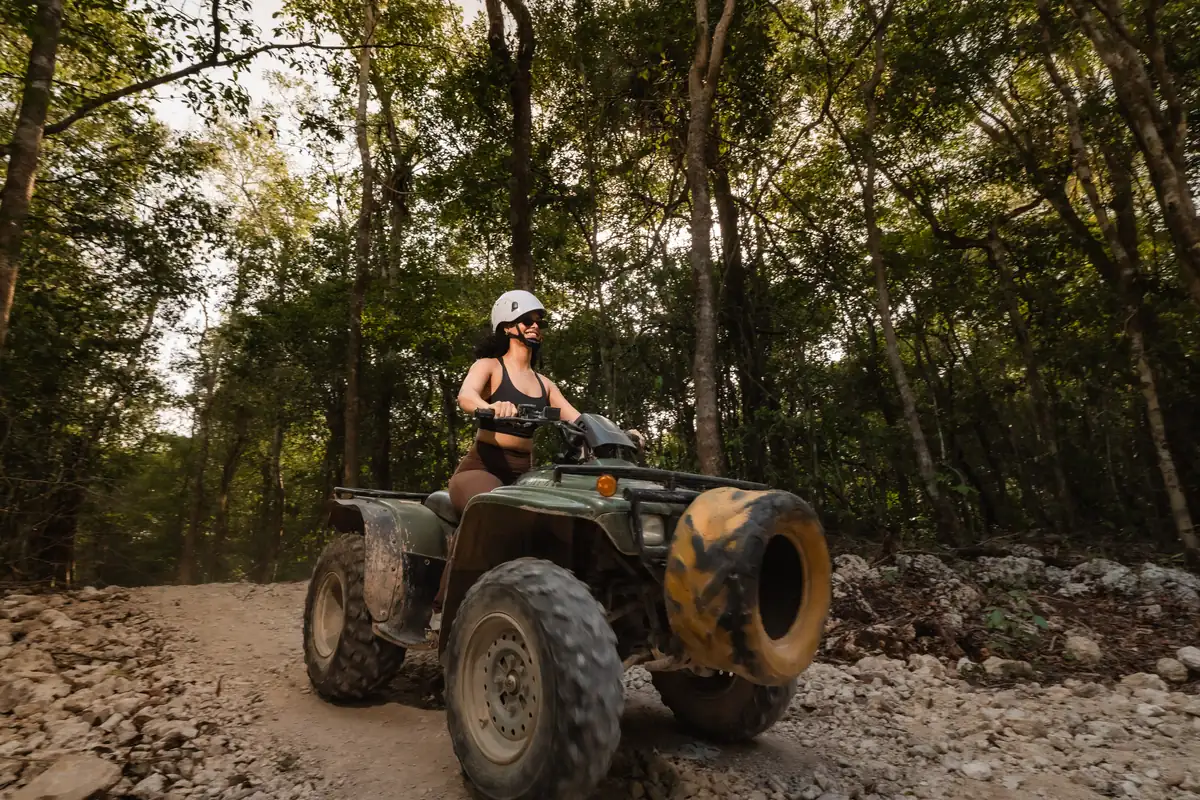
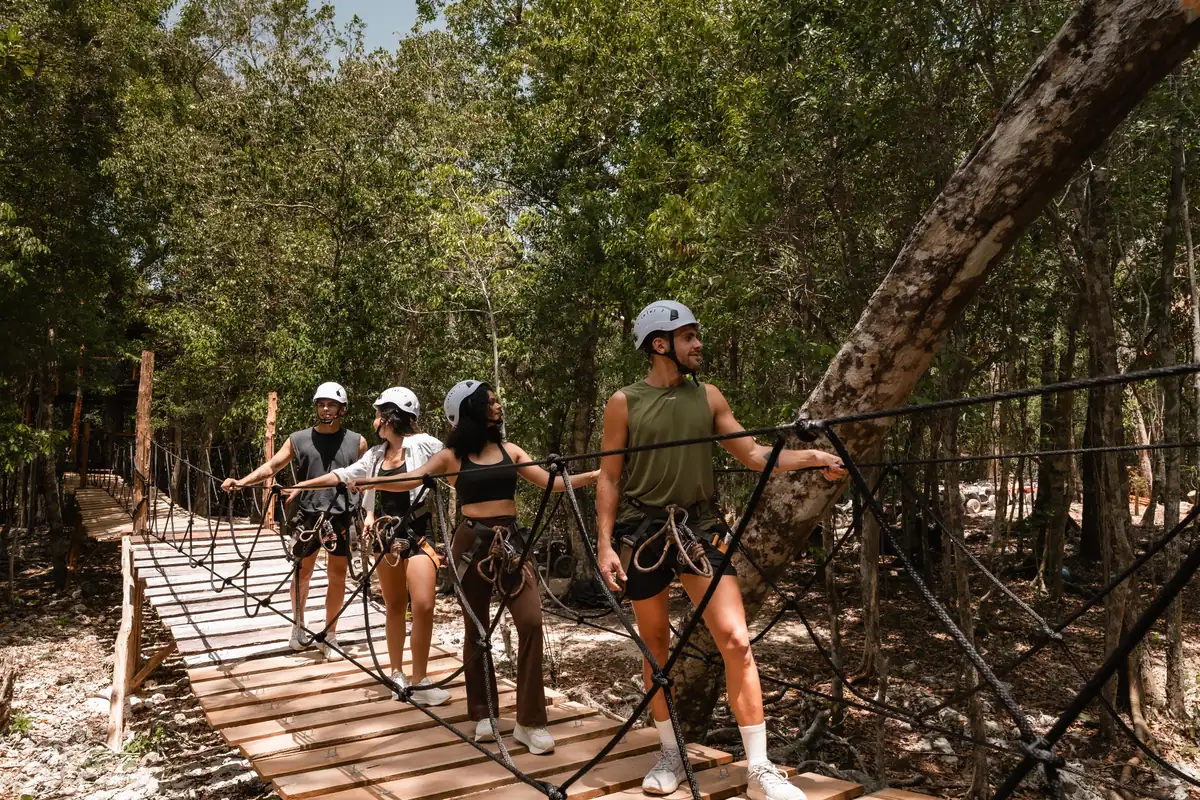
If you want to see the jungle that surrounded these coastal towns, our tours on the Ruta de los Cenotes near Puerto Morelos combine ziplines, ATVs or horseback riding with a cenote swim and a Maya snack, with hotel pickup from Cancún. Tours last about four hours, so they fit easily on a different day from your ruins visit. You can compare options on our tours page. For bigger sites like Chichén Itzá, Tulum or Cobá, see our guide to day trips from Cancún.
Frequently asked questions
Are there Maya ruins in Cancún?
Yes. El Rey and San Miguelito are in the Hotel Zone, and El Meco is just north of downtown near Puerto Juárez. San Miguelito is reached through the Museo Maya de Cancún.
Which Maya ruin in Cancún is best?
For a first visit, the Museo Maya plus San Miguelito gives you the most context in one stop. El Meco is the most impressive of the three sites, and El Rey is the easiest quick stop in the Hotel Zone.
What was the ancient name of Cancún's Maya sites?
The original names are not known. At El Rey, for example, INAH notes that no hieroglyphic inscriptions have been found, and El Meco takes its name from a 19th-century local resident's nickname.
How long do you need for the Cancún ruins?
About 30 to 50 minutes for El Rey, two to three hours for the Museo Maya and San Miguelito together, and about an hour at El Meco, plus travel.
Explore the jungle near Cancún
ATV, ziplines, a cenote swim and a tequila tasting on the Ruta de los Cenotes, with pickup from Cancún.
See All Tours