The ceiba (Ceiba pentandra) is the sacred tree of the Maya. In Maya cosmology it was the axis of the world: its roots reached down into the underworld, its trunk stood in the world of the living, and its branches held up the sky. In Yucatec Maya it is called ya'axche', often translated as "first tree," and it is the national tree of Guatemala.
It is also simply a remarkable tree. Young ceibas are covered in sharp conical spines, old ones grow huge buttress roots, and their seed pods are packed with a cotton-like fiber called kapok. Here is what makes the ceiba special, how to recognize one, and why so many still stand in the middle of towns and fields across the Yucatán Peninsula.
What is a ceiba tree?
Ceiba pentandra is a large tropical tree native to Mexico, Central America, the Caribbean and northern South America, and it also grows wild in West Africa. Agroforestry references describe it reaching 30 m (about 100 ft) or more, with a trunk that becomes heavily buttressed with age.
In English it is often called the kapok tree or silk-cotton tree. In Spanish it is simply ceiba. In the Yucatán you may hear ya'axche' from Maya speakers, a word you can add to the list in our guide to Yucatec Maya words and phrases.
The Yucatán Peninsula actually has more than one ceiba. Naturalist accounts from the region list three species in Yucatán: the giant Ceiba pentandra, Ceiba aesculifolia and Ceiba schottii, a smaller, spinier ceiba found only in the Yucatán Peninsula and northern Guatemala. Locally, the smaller species are often called pochote.
Why do young ceibas have spines on the trunk?
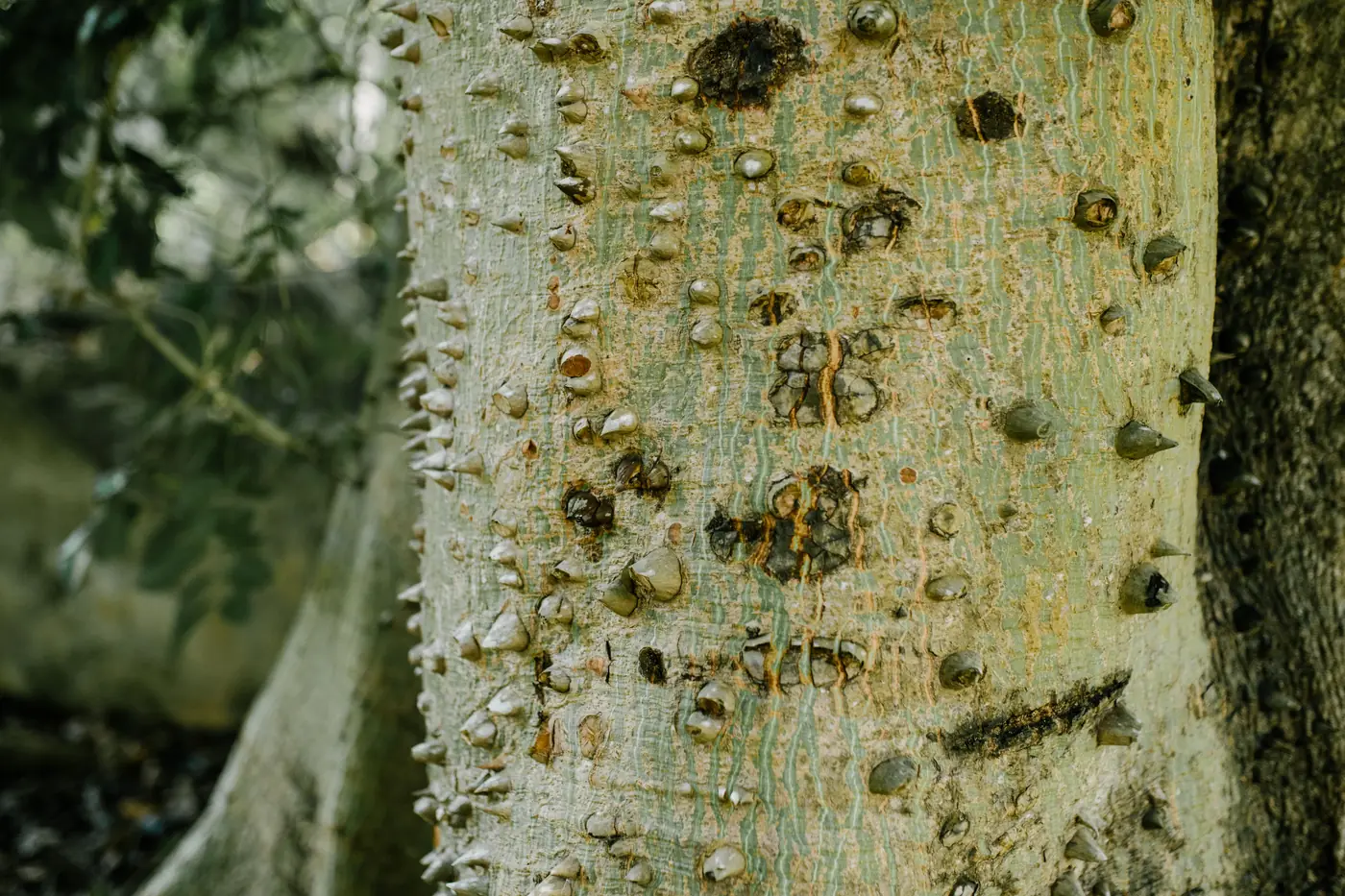
If you see a smooth gray-green trunk studded with thick, cone-shaped thorns, you are probably looking at a young ceiba. The spines protect the tree from animals while it is young. Older giants are easier to recognize by their size and the wide buttress roots at the base.
The spines mattered to the ancient Maya too. Archaeologists have found Maya incense burners, funerary urns and cache vessels from the Guatemalan highlands and the Petén lowlands decorated with rows of clay spikes that imitate the thorns of a young ceiba trunk.
What does the ceiba mean in Maya culture?
For the Maya, the ceiba was the axis mundi, the center post of the universe. Its roots reached Xibalbá, the underworld, the trunk belonged to the earthly realm, and the crown touched the heavens. You can read more about that underworld, and why cenotes were seen as doorways to it, in our article on Xibalbá and the cenotes.
The world tree shows up in Maya art. At Palenque, in Chiapas, the carved panels of the Cross Group show the world tree in the shape of a cross. The idea also survived in daily life: Maya villages were often built around a ceiba, which served as a gathering place for ceremonies and community decisions.
That meaning is not just ancient history. The Maya are a living people, and many Maya communities in the Yucatán still treat ceibas as sacred places where protective spirits live, leaving offerings and saying prayers at the base of the trunk. In 2024, when a 30-meter ceiba fell into the cenote at Xocén, a village near Valladolid considered the "center of the world" in some Maya cosmologies, Maya priests accompanied the divers and experts who studied the collapse.
The ceiba in Yucatán folklore
The ceiba also appears in darker stories. In Yucatec legend, the Xtabay, a beautiful and dangerous spirit woman, waits among the ceibas at night to lure men who wander through the forest. One local teacher quoted by Yucatán Today argues that colonial-era priests helped recast the sacred tree as a symbol of evil. The same legend is tied to a flower that gives its name to a regional liqueur, which we cover in our article on Xtabentún.
What is kapok, and what is the ceiba used for?
Ceiba fruits are woody capsules up to about 30 cm long. When they split open, they release seeds wrapped in silky fiber called kapok. The fluff helps carry the seeds on the wind and makes the fruit float, and a botanist at Yucatán's CICY research center argues that drifting seeds explain how the species ended up on both sides of the Atlantic.
Kapok was long used to stuff mattresses, pillows and life jackets, though synthetic fibers have largely replaced it. The seeds yield an oil used for soap, and the wood has been used for canoes and construction. In traditional medicine, parts of the tree have been used for wounds, burns and toothache.
Ceibas are also important for wildlife. The flowers open in the evening and are pollinated by bats, and when a large tree drops its fruit, the ground underneath can be covered in white fluff.
Why do Maya communities leave ceibas standing?
Travel through the Maya region and you may notice big ceibas left standing where the trees around them have been cleared. That is no accident: sources on Maya ethnobotany note that modern Maya often spare the ceiba when they cut timber.
There are several reasons:
- Respect. Many communities still consider the tree sacred, a home for protective spirits.
- Shade and gathering. Maya villages were traditionally built around a ceiba, which served as a meeting place.
- The law. In Mexico, removing a ceiba, even on private land, generally requires federal authorization from SEMARNAT, the environment ministry, and unauthorized removal can bring penalties.
- Ecology. A mature ceiba hosts a huge number of other species, gives birds nesting sites and feeds bats with its flowers, and its roots help prevent erosion.
Where can you see ceibas near Cancún?
You do not need to go deep into the jungle. Ceibas grow naturally in forests across the Yucatán Peninsula, and they are planted as ornamental trees too: in Mérida, for example, they shade parks and road medians. A few tips for spotting them:
- Look up. Mature ceibas are often the tallest trees around, with a wide crown rising above the surrounding forest.
- Check the base. Large wing-like buttress roots spreading out from the trunk are a good clue.
- Look at young trunks. Smaller trees with cone-shaped spines are almost certainly a ceiba or pochote.
- Visit the villages. Many Maya villages and town squares have a large ceiba near the center, so keep an eye out on any day trip inland.
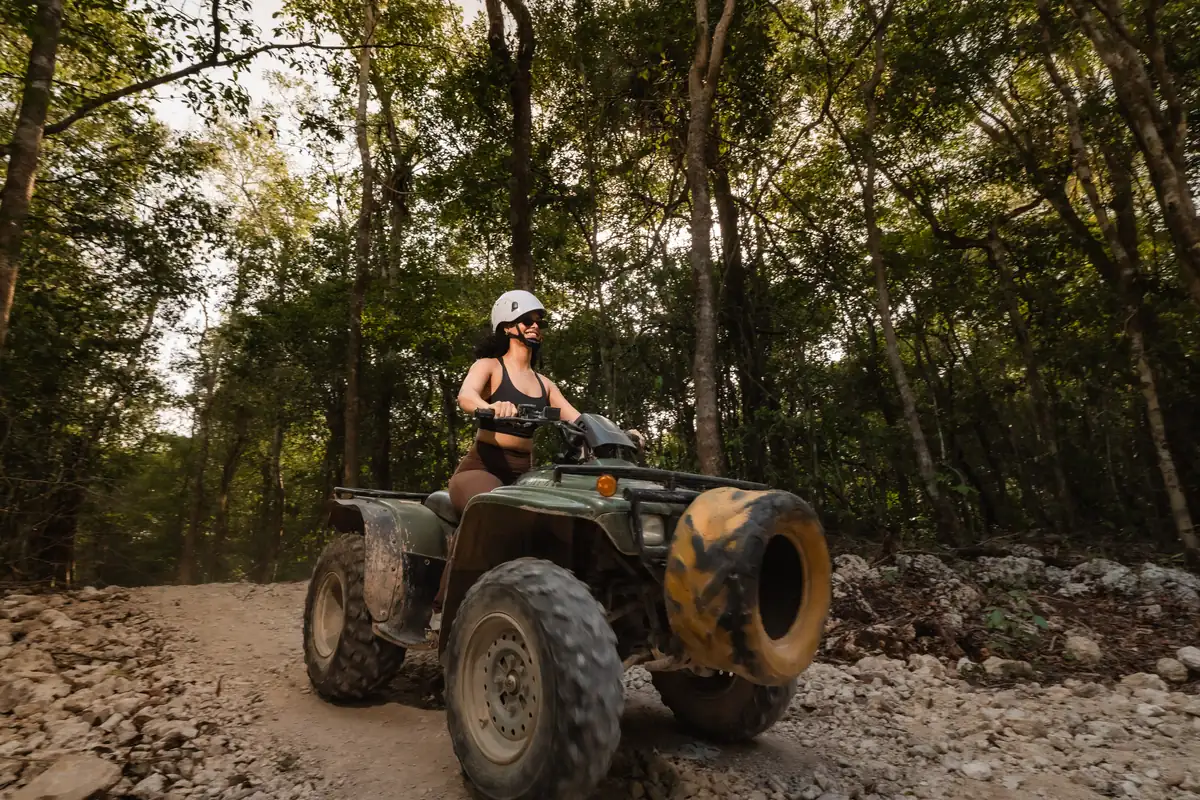
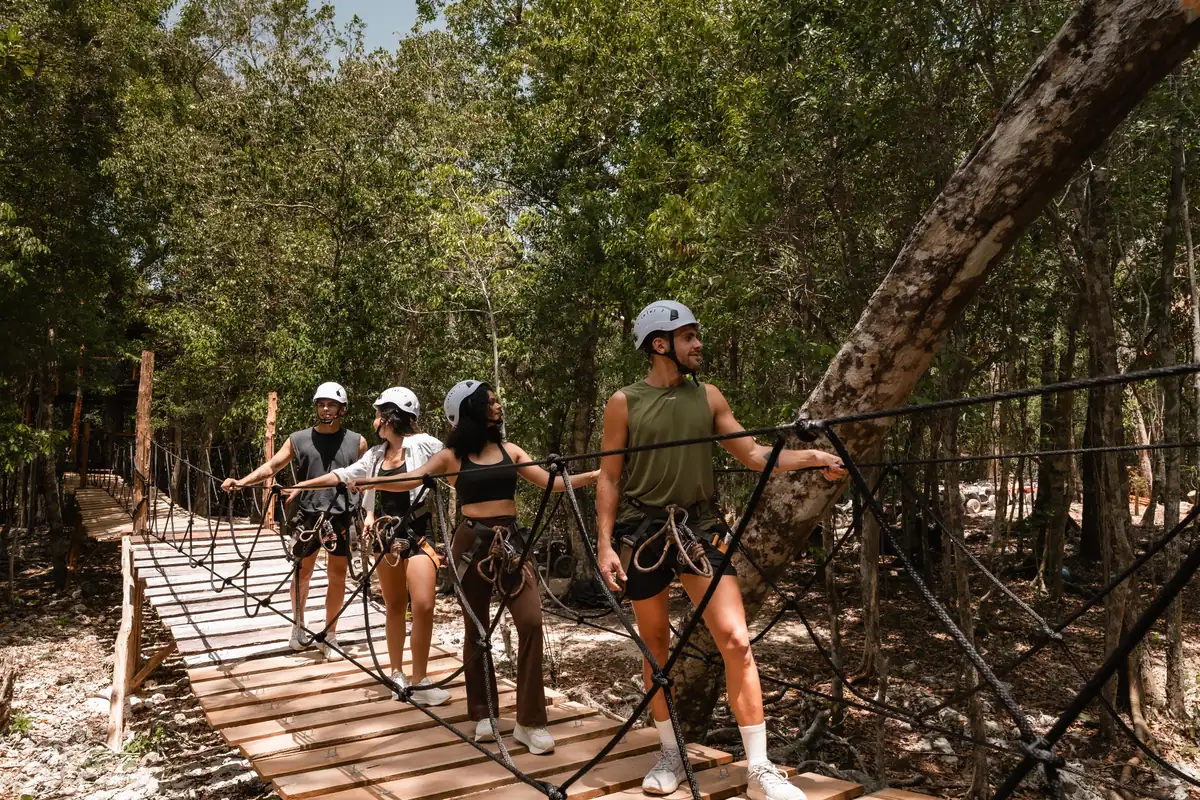
The forest along the Ruta de los Cenotes is part of this same peninsula landscape. If you join one of our jungle tours from Cancún, ask your guide to point out the trees you pass along the trails. Please look but don't touch: the spines are sharp, and some trees in this forest, like the chechén, can cause a painful rash. We explain how to tell them apart in our guide to the chechén and chacá trees.
Frequently asked questions
What does the ceiba tree symbolize for the Maya?
It represents the world tree, the axis that connects the underworld, the earth and the sky. Many Maya communities still consider it sacred and leave offerings at its base.
Is the ceiba the national tree of Guatemala?
Yes. The ceiba is Guatemala's national tree, a nod to its central place in Maya culture.
Why does the ceiba have thorns?
Young ceibas grow thick conical spines on their trunks that protect them from animals. The smaller Yucatán species, often called pochote, can be even spinier.
Is it illegal to cut down a ceiba in Mexico?
Removing one generally requires federal authorization from SEMARNAT, even on private land, and cutting one without permission can lead to fines.
Explore the jungle near Cancún
ATV, ziplines, a cenote swim and a tequila tasting on the Ruta de los Cenotes, with pickup from Cancún.
See All ToursSources
- Ceiba (Wikipedia)
- Sacred Ceiba tree: flowers, kapok, spines and incense burners (FLAAR Mesoamerica, Nicholas Hellmuth)
- La ceiba (Herbario CICY, Centro de Investigación Científica de Yucatán)
- Ceiba pentandra (World Agroforestry, Useful Trees)
- Can you cut down a ceiba tree in Yucatán? (Yucatán Magazine)
- Ceibas of the Yucatán (Jim Conrad, Backyard Nature)