The chechén (Metopium brownei), also called black poisonwood, is the tree you most want to avoid touching in the Yucatán jungle. Its sap contains urushiol, the same irritant found in poison ivy, and contact can cause a painful, blistering rash. The chacá (Bursera simaruba), known in English as gumbo-limbo or "tourist tree," is its famous neighbor: in Maya tradition, a wash made from chacá bark or leaves is used to calm the chechén rash.
The two trees often grow close together in the forests of Quintana Roo and Yucatán, and a well-known Maya legend explains why. Here is how to tell them apart, what the folk remedy is (and isn't), and what to do if you get a reaction on a jungle trail.
What is the chechén tree?
Chechén is a member of the cashew family (Anacardiaceae), the same family as poison ivy, poison oak and poison sumac. It grows in the Yucatán Peninsula and along the Gulf side of Mexico to Veracruz, as well as in Belize, northern Guatemala, Cuba, Jamaica and the Dominican Republic.
The trouble is the sap. The bark and the sap underneath it contain urushiol, which can cause contact dermatitis: redness, intense itching, burning pain and blisters. You can be exposed by brushing against the leaves or trunk, touching something that touched the sap, or breathing smoke from burning chechén wood.
Despite all that, chechén is also a prized hardwood. Its wood is used for furniture and carpentry in Mexico and Central America, and live trees and freshly cut logs have to be handled with care.
What is the chacá, the "tourist tree"?
Chacá (also spelled chaká) is Bursera simaruba, the gumbo-limbo. It is one of the easiest trees in the Yucatán to recognize because of its smooth bark that is reddish or coppery and peels off in thin papery sheets. That red, peeling look is why it is nicknamed the "tourist tree": it resembles sunburned skin.
Chacá is a medium-sized tree that can reach about 15 meters in the region. Birds eat its fruit, and its branches root so easily when stuck in the ground that the species can be grown from cuttings.

Do chechén and chacá really grow together?
Often, yes, though not always. Both trees thrive in the semi-deciduous forests that grow on the Yucatán's limestone, so they share the same habitat. Atlas Obscura points to another likely reason: birds eat the fruit of both trees and scatter their seeds, so the two often sprout close to each other.
That is the origin of the popular saying that wherever there is a chechén, a chacá is growing nearby. It is a useful reminder, but it is not a guarantee, and it is not a substitute for proper care.
Does chacá really cure the chechén rash?
In Maya traditional medicine, chacá is the classic remedy for chechén. The most common preparation is a tea made by boiling the leaves or bark, applied to the skin as a wash several times a day. Some people rub the sap from just under the bark directly on the rash. Similar folk uses are recorded in Belize and Guatemala.
Some laboratory work has identified anti-inflammatory and antioxidant compounds in chacá, but the home remedy has not been tested in clinical trials. Treat it as what it is: a traditional practice with a long history, not a proven treatment.
What to do if you touch chechén
If you think you brushed a chechén, act quickly:
- Wash the skin with soap and plenty of water as soon as possible to remove as much sap as you can.
- Don't scratch and don't touch your face or eyes with unwashed hands.
- Wash clothes, gloves and gear that touched the tree, because the sap can stay on fabric.
- Use standard rash care such as cool compresses or calamine lotion, and ask a pharmacist for advice.
- Get medical care promptly if the rash is severe or widespread, if it is on your face, eyes or genitals, or if you have trouble breathing, dizziness or serious facial swelling.
The Maya legend of Kinich and Tizic
The trees come with one of the best-known legends of the Yucatán. Like any oral tradition, it is told in different versions, and even the names vary. In a widely told version, two warrior brothers, Kinich and Tizic, served the same lord. Kinich was kind and loved by his people; Tizic was proud and ruthless.
Both fell in love with the princess Nicté-Ha. When she chose Kinich, Tizic challenged his brother to a fight to the death, and the two killed each other. In the underworld they asked the gods for one more chance to return and see Nicté-Ha. The gods agreed on one condition: they had to come back together and always stay close.
Tizic returned as the chechén, dark and poisonous, and Kinich as the chacá, whose bark soothes the harm his brother causes. In some tellings Nicté-Ha becomes a white water lily. Other versions simply call the brothers Chechén and Chaká, but the message is the same: harm and cure grow side by side.
How to recognize chechén and chacá on a jungle trail
You don't need to be a botanist to avoid trouble. These are the main clues.
Chechén (avoid)
- Black marks: dark or black spots and streaks on the bark and leaves, where sap has leaked and turned black in the air.
- Bark: gray and scaly, often looking blotchy.
- Leaves: compound, with a few shiny, slightly wavy leaflets.
- Fruit: small, egg-shaped berries.
Chacá (the "tourist tree")
- Bark: smooth and red to copper, peeling in thin sheets like sunburned skin.
- Color: the trunk can look reddish or greenish, depending on how much bark has peeled.
- Feel: smooth rather than scaly, with no black streaks.
The safest rule is simple: if you are not sure what a tree is, don't touch it.
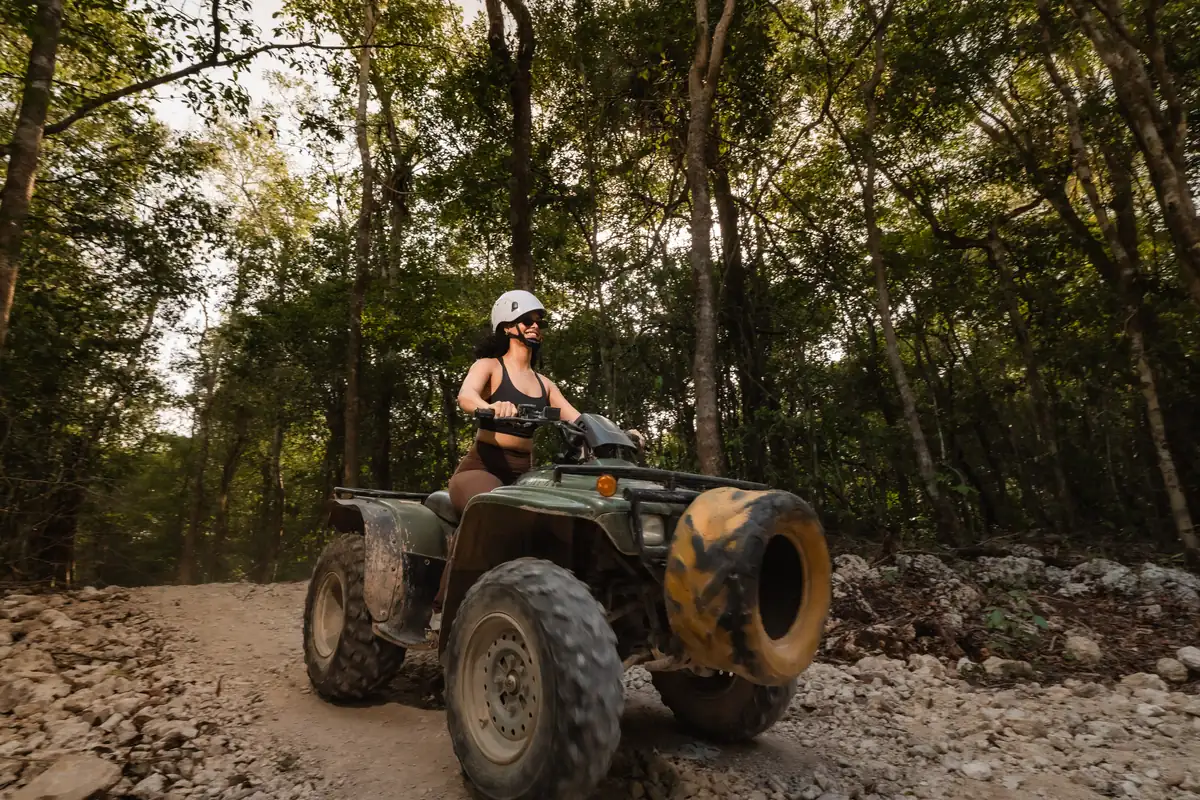
Staying safe on ATV and jungle trails
Contact usually comes from small moments: grabbing a trunk for balance or brushing past low branches. A few habits help:
- Keep your hands on the handlebars of the ATV or on the reins, not on the trees beside the trail.
- Wear closed-toe shoes and consider light long pants for walks in the forest. Our what to bring guide has the full list.
- Don't pick leaves, sticks or bark as souvenirs, and don't sit or lean on unknown trunks.
- Don't stand under trees in the rain if you can avoid it, since water can carry sap.
- Wash up afterward, especially your hands and forearms, before eating.
See the jungle for yourself near Cancún
Both trees grow in forests across the Yucatán Peninsula, so they are worth knowing on any jungle trail near Cancún, including the Ruta de los Cenotes near Puerto Morelos. On one of our ATV and zipline tours, ask your guide about the trees you pass, and enjoy them from the trail.
If you are curious about other plants and animals of the area, read about the sacred ceiba tree and the jungle animals near Cancún.
Frequently asked questions
Is the chechén tree dangerous?
Its sap contains urushiol, which causes a painful, blistering rash in many people. It is not usually life-threatening, but severe reactions, especially around the eyes or with breathing trouble, need medical care.
Why is the chacá called the tourist tree?
Its red, peeling bark looks like sunburned skin, a joke on visitors who spend too long in the sun.
Does chacá cure chechén rash?
Chacá is a traditional Maya remedy for the rash, used as a wash made from the bark or leaves. It has not been proven in clinical trials, so wash the skin first and see a doctor for serious reactions.
Is chechén related to poison ivy?
Yes. Both belong to the cashew family and both produce urushiol, the oil that causes the rash.
Explore the jungle near Cancún
ATV, ziplines, a cenote swim and a tequila tasting on the Ruta de los Cenotes, with pickup from Cancún.
See All ToursSources
- Metopium brownei (Wikipedia)
- The incredible coincidence of a poisonous tree growing next to its antidote (Atlas Obscura)
- Bursera simaruba (Florida Native Plant Society)
- El árbol más peligroso de México se encuentra en Yucatán (Por Esto)
- Veneno y antídoto: la leyenda maya del chechén y el chacá (Posta Yucatán)
- Chechén and Chacá (Mayan.org)