The forest behind Cancún and Puerto Morelos is low, dense tropical jungle growing on limestone, and it is full of life. On a typical half-day outing you have a good chance of seeing iguanas, coatis, colorful birds and butterflies. Spider monkeys, agoutis and parrots are possible with some luck. Jaguars live in the region, but you should not expect to see one.
This guide covers the animals you are most likely to meet in the jungle near Cancún, the rarer ones, where to look, and how to behave around wildlife so it stays wild.
Which animals are you most likely to see?
Black spiny-tailed iguana
The large gray-and-black lizards sunning on rocks, walls and ruins are usually black spiny-tailed iguanas (Ctenosaura similis). They live along the coast from Tabasco around the Yucatán Peninsula. Males can reach about 1.3 meters (4 feet) including the tail, and young ones are olive-green. Adults eat mostly leaves, flowers and fruit. They are also fast: Guinness World Records lists this species as the fastest reptile on land, at about 35 km/h (around 21 mph).
Coati (tejón or pizote)
The white-nosed coati looks like a slim raccoon with a long snout and a long, ringed tail. In Mexico it is usually called tejón; in Central America, pizote. Coatis are active during the day. Females and their young travel in noisy groups called bands, while adult males are usually solitary. They eat almost anything: fruit, insects, eggs and small animals. Where people feed them they can become bold, which is exactly why you should never feed them (more on that below).
Agouti (sereque)
The Central American agouti, called sereque in Mexico, is a rodent about the size of a rabbit, with long thin legs and a brown coat. You will usually see one trotting across a trail and freezing before it dashes off. Agoutis eat mainly fruit and seeds and bury extra seeds to eat later. The ones they forget sprout, which makes them important planters of the forest. They are active by day, though they become more nocturnal where they are disturbed.
Which birds live in the jungle near Cancún?
Birds are the easiest wildlife to see, especially in the early morning.
- Turquoise-browed motmot (toh): a green, turquoise and rufous bird with two long tail feathers ending in bare "rackets." It wags its tail like a pendulum, which is why it is also called pájaro reloj (clock bird). Locals know it by its Maya name, toh, and it features in Maya fables. It digs nesting tunnels in earth banks and limestone, so it is often seen around cenotes.
- Yucatan jay: a black-bodied jay with bright blue wings and back that lives mainly on the Yucatán Peninsula. Young birds look surprisingly different, with white heads and yellow bills.
- Yucatan parrot (yellow-lored amazon): a small green parrot found throughout the peninsula. Adult males have a yellow patch in front of the eye and a white forehead.
- Keel-billed toucan: lives in the forests of southeastern Mexico, Belize and northern Guatemala and is Belize's national bird. It is listed as Near Threatened. It is a lucky sighting rather than something to expect on a short trip.
Other birds commonly recorded in the jungle around Puerto Morelos include green jays, black-headed trogons, social flycatchers and orioles. Our guide to the ceiba, the sacred Maya tree explains one of the trees many of these birds use.

Can you see monkeys near Cancún?
Yes, but not everywhere. The monkeys found in the forest around Puerto Morelos are Geoffroy's spider monkeys, a long-limbed species that swings through the canopy using its arms and prehensile tail. They eat mostly ripe fruit and live in groups that split into small foraging parties during the day, so you often see just two to six together.
Geoffroy's spider monkey is classified as Endangered. It needs large areas of forest and has suffered from habitat loss and capture for the pet trade. Seeing one in the wild is a privilege, not a guarantee.
Where to look: the Puerto Morelos botanical garden
The Jardín Botánico Dr. Alfredo Barrera Marín, just south of the Puerto Morelos turnoff on the Cancún–Playa del Carmen highway, protects about 65 hectares of forest with roughly 2 km of easy, flat trails. It is a good place for birdwatching, and it is home to what birding guides describe as the only coastal troops of spider monkeys left in the area. Go early, bring insect repellent, and check opening hours and fees before you go.
Are there crocodiles and jaguars?
Crocodiles: Two species, the American crocodile and Morelet's crocodile, live in the Nichupté lagoon system and the mangroves of Cancún's Hotel Zone. Local authorities ask people never to feed them, because it teaches crocodiles to associate humans with food. If you see one outside its habitat, call 911.
Jaguars: The Yucatán Peninsula is a stronghold for jaguars in Mexico. The 2024 national jaguar census estimated 5,326 jaguars in the country, about 1,700 of them on the peninsula. Jaguars are protected, elusive and very shy of people. Treat any tour that promises jaguar sightings in the wild with skepticism.
What can you realistically see on a jungle tour?
A half-day tour near Cancún is mostly about the experience: the forest, the cenote and the activity. Wildlife sightings are a bonus. Realistic expectations:
- Very likely: iguanas, butterflies, lizards, and birds such as jays and flycatchers.
- Fairly likely: motmots (especially near cenotes), parrots flying over, coatis.
- Possible with luck: agoutis, spider monkeys, toucans.
- Very unlikely: jaguars and other wild cats.
Many animals, and most birds, are more active in the early morning and late afternoon and hide during the hottest hours. Moving quietly and keeping your eyes on the trail edges and treetops helps. Also watch out for plants: our article on the chechén, the jungle's "poison tree" explains which tree to avoid touching.
How should you behave around wildlife?
- Never feed wild animals. Coatis, monkeys and crocodiles that are fed lose their fear of people, can bite, and may end up being captured and relocated. Human food also makes them sick.
- Keep your distance. Use your zoom, not your feet. If an animal changes its behavior because of you, you are too close.
- Don't touch or pick up animals, including baby animals that seem alone. The parent is usually nearby.
- Don't buy wildlife "photo ops" with captive monkeys, parrots or other wild animals.
- Stay on trails and follow your guide's instructions.
- Take your trash with you, including food scraps.
See the jungle for yourself
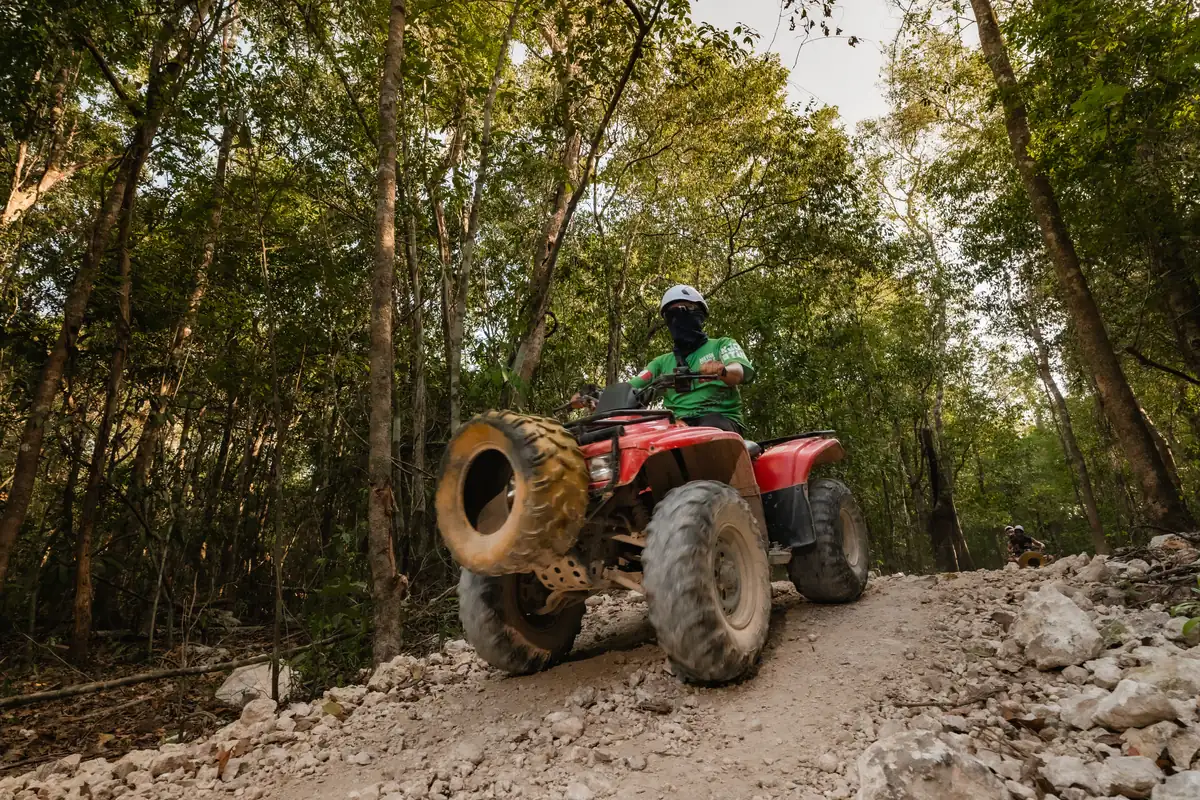
Our park is at km 18.5 of the Ruta de los Cenotes, near Puerto Morelos, surrounded by the same type of forest described here. Whether you choose a jungle tour with ATVs and ziplines or the quieter Cenote Tour, keep your eyes open and ask your guide about the animals and plants of the area. Compare all tours on our tours page, and for more to do nearby, read our guides to the Ruta de los Cenotes and the Puerto Morelos reef.
Frequently asked questions
Are there monkeys in Cancún?
Geoffroy's spider monkeys live in the forests of the northern Yucatán Peninsula, including near Puerto Morelos, but they are endangered and not common. You are unlikely to see them in the Hotel Zone.
What is the animal that looks like a raccoon in Cancún?
That is the white-nosed coati, called tejón in Mexico. Coatis are active during the day and often approach people for food, but you should not feed them.
Are there jaguars near Cancún?
Jaguars live in the Yucatán Peninsula, which holds about a third of Mexico's jaguars, but they are elusive and rarely seen. Tours should never promise jaguar sightings.
Is it dangerous to walk in the jungle near Cancún?
On guided trails the main risks are heat, insects and slippery ground. Stay on the trail, keep your distance from animals and follow your guide's instructions.
Explore the jungle near Cancún
ATV, ziplines, a cenote swim and a tequila tasting on the Ruta de los Cenotes, with pickup from Cancún.
See All ToursSources
- Turquoise-browed motmot (Wikipedia)
- Geoffroy's spider monkey (Wikipedia)
- Black spiny-tailed iguana (Mexican Terrestrial Life)
- Jardín Botánico Dr. Alfredo Barrera Marín (Birdingplaces)
- Mexico's jaguar numbers jump up 30% in newest national census (Global Conservation)
- Cancún warns: don't feed the crocodiles (Riviera Maya News)