Chaac (also spelled Chaak or Chac) is the Maya god of rain, thunder and lightning. He strikes the clouds with a lightning axe to make them release rain, he was imagined as four gods standing at the four directions, and he was honored with offerings in caves and cenotes. On the Yucatán Peninsula, where there are almost no rivers and farming depends on the rainy season, he was one of the most important gods of all.
He is not only a figure from the past. In parts of Yucatán, farming families still hold a rain ceremony called ch'a cháak during the dry season. Here is who Chaac is, where you can see his face carved in stone, and why he is so closely tied to the cenotes around Cancún.
Who is Chaac?
Chaac controls rain, and with it the maize harvest that Maya life depended on. Encyclopedia sources describe him striking the clouds with his axe to produce thunder and rain. In Classic Maya times (roughly AD 200 to 900), artists gave him a human body with reptilian or amphibian scales, fangs, large round eyes and a long, curling nose. He often wears a shell as an ear ornament and carries a shield along with his axe.
You will see several spellings:
- Chaac is the most common in English.
- Chaak (or Cháak) follows modern Yucatec Maya spelling.
- Chac appears in older books and in Encyclopaedia Britannica.
They all refer to the same god.
Why are there four Chaacs?
Like other major Maya gods, Chaac could appear as four gods at once, one for each direction, each with its own color:
- East: red
- North: white
- West: black
- South: yellow
Some sources add a fifth Chaac at the center, linked to green. In 16th-century Yucatán, the eastern Chaac was called Chac Xib Chaac. This four-direction pattern runs through Maya thought and also shapes the modern ch'a cháak ceremony described below. A large part of the Dresden Codex, one of the few surviving Maya books, deals with the Chaacs and their activities. If you want more on how the Maya organized time and space, see our post on the Maya calendar.
After the Spanish conquest, the Chaacs blended with Christian figures. Britannica notes they became associated with Catholic saints and were often pictured on horseback.
Where can you see Chaac masks?
The most dramatic place is in the Puuc hills of western Yucatán, south of Mérida. Puuc buildings are famous for their carved stone facades, and Chaac's long-nosed face appears again and again.
Kabah: the Codz Poop
At Kabah, the Codz Poop (INAH spells it Codz Pop) has a facade covered with hundreds of stone masks of Chaac, stacked one above another. It is one of the most striking buildings in the Maya world. INAH notes that Kabah reached its peak between about 750 and 900, alongside its larger neighbor Uxmal, and the two cities were connected by a sacbé, a raised white road.
Chaac at Chichén Itzá
Chichén Itzá also has Chaac masks on several buildings, including the Temple of the Three Lintels and the Nunnery complex. But its most important connection to the rain god is not a building. It is a hole in the ground.

What was offered to Chaac at the Sacred Cenote?
The Sacred Cenote at Chichén Itzá is a large, open sinkhole with sheer walls. Maya and Spanish colonial sources say it was devoted to Chaac and was a place of pilgrimage.
When Edward H. Thompson dredged it in the early 1900s, and when Mexico's National Institute of Anthropology and History (INAH) and divers from CEDAM explored it again in 1961, they recovered:
- jade beads and plaques (the most common material)
- gold and copper objects
- pottery, including bowls that held copal incense
- textiles, wood, rubber and shell
- human remains
Jade, gold and copper do not occur naturally in Yucatán, so these offerings were carried in from distant regions. Spanish bishop Diego de Landa wrote in the 1560s that people were thrown into the cenote alive during droughts. Remains in the cenote confirm that human sacrifice happened, but historians caution that his account does not show how often. The large majority of what was found were objects.
Nearby, the Balankanché cave held dozens of incense burners decorated with Chaac's face, along with miniature grinding stones and small pots, left near a pool of clear water. For more on how caves and cenotes connected to the underworld, read Xibalbá and the cenotes.
Why did water matter so much in Yucatán?
Unlike most of Mexico, the northern Yucatán Peninsula has no surface rivers. Rain soaks straight through the porous limestone into a huge underground aquifer. Cenotes are the places where that water is visible and reachable. We explain the geology in how cenotes were formed.
For the Maya, this meant:
- Drinking water came largely from cenotes and wells dug down to the water table.
- Farming depended on the rainy season arriving on time. Maize fields, or milpas, were rain-fed.
- Drought was a real danger to whole communities.
So the god who brought rain sat close to the center of daily life, and the cenotes where his water collected were natural places to ask for it.
What is the ch'a cháak ceremony?
Ch'a cháak is a community ritual to ask the rain deities for rain, held during the dry season in some Maya communities of Yucatán. It is still practiced, though less than before.
According to researchers from the Universidad Autónoma de Yucatán and the Universidad de Bonn, a typical ceremony includes:
- Purification of the site and participants with plants and copal incense.
- An altar made of wood and leaves, tied with vines, which acts as a map of the Maya cosmos.
- Offerings of saka' (a maize drink with honey) and balché (a fermented drink made from tree bark, cenote water and honey), served in gourd bowls.
- Special breads of maize and squash seeds cooked in a pib, an earth oven.
- Lightning tools carved from wood by the h-men, the traditional ritual specialist, to call the rain.
Descriptions of the ceremony also mention four boys, one for each direction, who croak like frogs during the ritual, echoing the four Chaacs. In October 2025, the Diario de Yucatán reported a ch'a cháak in Tzucacab, where farmers revived the ritual after skipping it the previous year. The h-men led prayers to the deities while families prepared the food. The paper noted that the ceremony has incorporated Catholic elements while keeping its original essence.
This is a living community practice, not a show. If you are ever invited to one, follow your hosts' lead and ask before taking photos. Our post on visiting Maya communities responsibly has more tips.
Feel the connection near Cancún
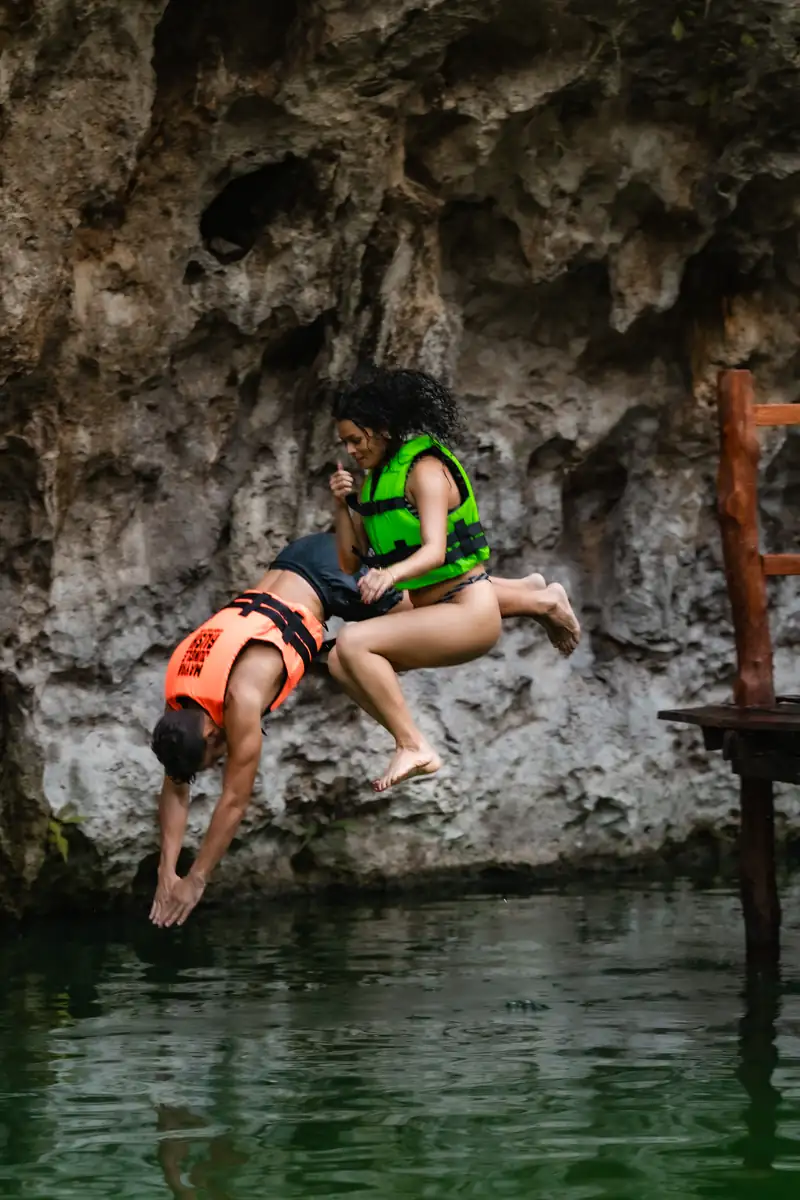
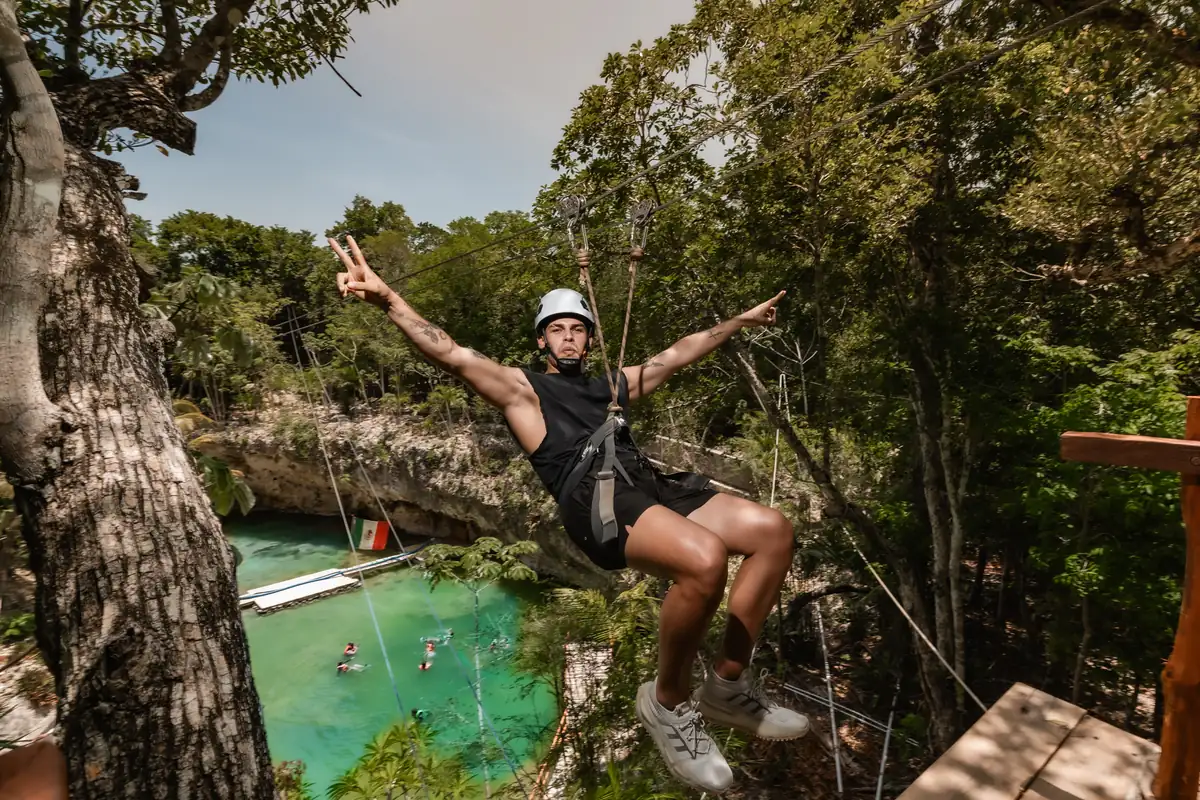
You can understand Chaac better by spending time in the landscape he ruled: flat limestone, dense jungle and deep blue water underground. At Mayan Jungle Rush, on the Ruta de los Cenotes near Puerto Morelos, our Cenote Tour (adults only) includes about three hours at a jungle cenote and a Maya snack. Remember to bring only biodegradable sunscreen; see our cenote prep guide.
Frequently asked questions
What is Chaac the god of?
Chaac is the Maya god of rain, thunder and lightning. He was also closely linked to agriculture, especially maize, because crops depended on rain.
What does Chaac look like?
In Classic Maya art he has a long, curling nose, fangs, large round eyes and scaly skin, and he usually holds a lightning axe. His masks cover buildings at Puuc sites like Kabah.
Is Chaac the same as Tlaloc?
They are separate gods with similar roles. Tlaloc is the central Mexican rain god and Chaac the Maya one, though the cultures were in contact: INAH describes some incense burners at Balankanché as depicting Chaac or Tlaloc.
Is Chaac still worshipped today?
Some Maya farming communities in Yucatán still hold the ch'a cháak ceremony to ask for rain, led by an h-men and often blended with Catholic prayers.
Swim in a jungle cenote
Spend 3 hours at our cenote on the Ruta de los Cenotes, with pickup from Cancún.
See the Cenote Tour