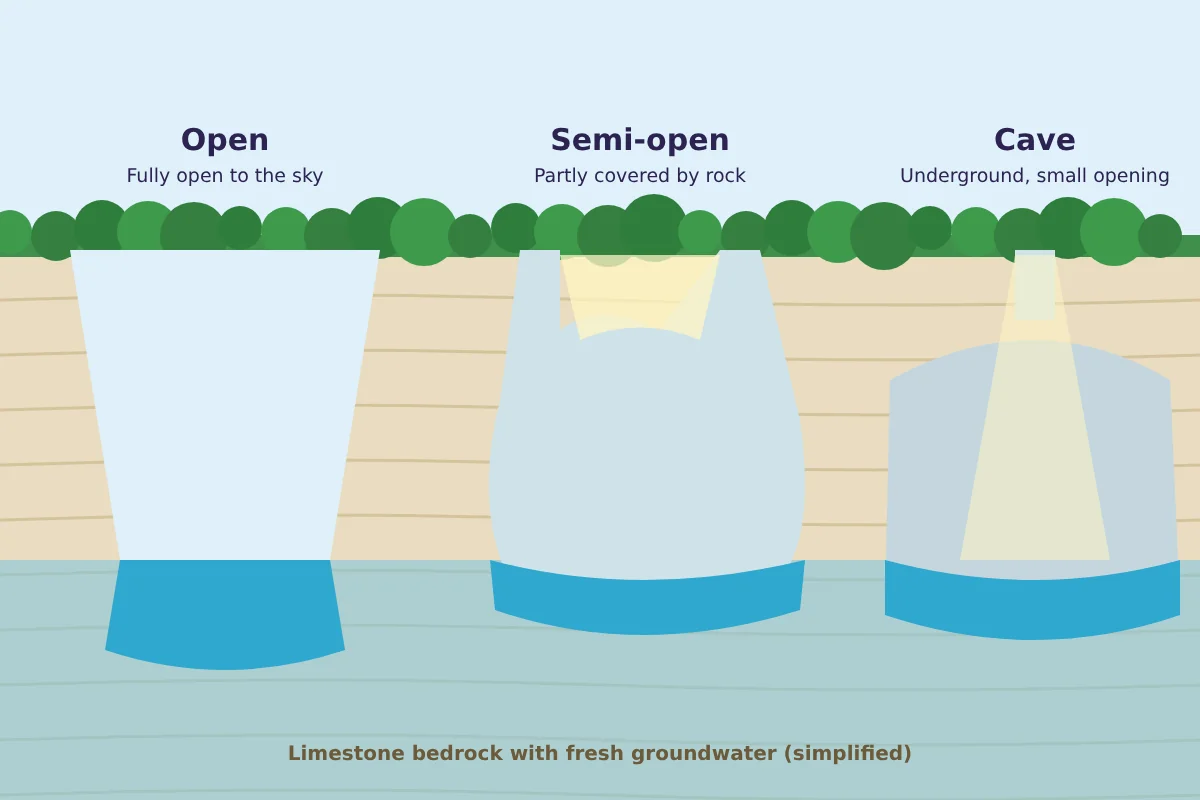
There are three main types of cenotes: cave (also called underground or closed) cenotes, semi-open cenotes and open cenotes. The difference is how much of the original rock ceiling is still standing. Because ceilings erode and collapse over time, the three types are often described as stages of a cenote's life, from a young, enclosed cave to an old, sunlit pool.
You will also see a fourth label, "ancient" cenotes, in travel guides and tour descriptions. That term is not used consistently, so we explain below what people usually mean by it. Then we cover what swimming in each type actually feels like, and how to visit any of them safely and respectfully.
How do cenotes go from cave to open pool?
Every cenote on the Yucatán Peninsula starts underground. Rainwater, made slightly acidic by carbon dioxide, dissolves the limestone and hollows out a cave below the surface. As the cave grows, its ceiling gets thinner. Eventually part of it collapses and lets in daylight. If you want the deeper geology, including the asteroid connection, read how cenotes were formed.
From there, the cenote keeps changing:
- Cave stage. The ceiling is mostly intact. A small hole or crack is the only way in.
- Semi-open stage. More of the roof falls in. Large sections of ceiling remain, and sunlight enters through one or more openings.
- Open stage. After a very long time, the ceiling is gone. What is left looks like a round pond or small lake with rock walls or sloping banks.
Geologists also note that cenotes are not permanent. Over long periods, they can fill with sediment and dry out.
Cave cenotes (underground or closed)
Cave cenotes are the youngest in this scheme. You enter through a narrow opening, often down stairs or a ladder, into a chamber that may be dim or lit by a single shaft of light. Stalactites hang from the ceiling, and sometimes tree roots drop all the way down to the water.
What swimming is like: Calm, cool and quiet. The water is usually very clear because little sun and few leaves reach it, which also means less algae. Sound echoes, and the light can look almost theatrical at midday. Some people find enclosed spaces uncomfortable, so if you are unsure, try a semi-open cenote first.
Good to know:
- Bats may roost near the ceiling. Keep your voice down and avoid flash photography aimed at them.
- Never swim into side passages or under ledges. Cave diving requires special training, and only certified cave divers with proper guides should go beyond the open water.
Semi-open cenotes
Semi-open cenotes are the in-between stage. Part of the roof has fallen in, so you get a mix of open sky and overhanging rock. Many of the most photographed cenotes in the region are this type, because sunlight streams through the gaps and lights up the water in beams.
What swimming is like: The best of both worlds for many visitors. You can float in the sun in one area and drift into shade under the rock in another. Water temperature is usually comfortable, and clarity is often excellent.
Good to know: Check where it is safe to jump. Some semi-open cenotes have platforms built for it. Others have rock ledges just below the surface.
Open cenotes
Open cenotes are the oldest stage. The whole ceiling has eroded away, leaving a pool open to the sky, often ringed by plants, with fish living in the water. Some look like jungle ponds, others like deep round wells with vertical walls. The Sacred Cenote at Chichén Itzá is a famous example of a large open cenote.
What swimming is like: More like a natural lake. The water is warmer near the surface on sunny days, you will often see small fish, and there may be aquatic plants along the edges. Sunlight helps algae grow, so the water can look greener than in a cave cenote.
Good to know: Open cenotes have more sun exposure. Bring a hat and a cover-up rather than piling on sunscreen.
What is an "ancient" cenote?
This is where sources disagree. Some guides use "ancient cenote" for the geologically oldest cenotes, those that have gone through several collapses and partly filled with sediment, so they look shallower or pond-like. Others use it for cenotes with archaeological history, where offerings and human remains have been found. A few tour operators use it simply as a marketing word for any old-looking cenote.
Our advice: treat "ancient" as a description, not a scientific category. If a tour uses the term, ask what it means for that specific site. Is it shallow? Is it a cave? Is it a protected archaeological site where swimming is not allowed? Remember that in Maya belief, cenotes and caves were connected to the underworld and to the rain god, and many held offerings. You can read more in our post on Chaac, the Maya rain god.
Cenote safety and etiquette
Cenotes are drinking-water sources for many communities and windows into an aquifer that connects to the coast and the reef. In this kind of limestone, pollution travels quickly. A 2021 study of sunscreen use in the Mexican Caribbean estimated that hundreds of tons of sunscreen reach Quintana Roo's freshwater and marine ecosystems each year, including cenotes.
Before you get in:
- Shower if the site has showers. It rinses off lotion, repellent and sweat.
- Use only biodegradable sunscreen, or none. Many cenotes, including ours, require this. A rash guard does the job better.
- Skip insect repellent right before you swim.
In the water:
- Wear a life jacket if you are not a strong swimmer. Cenotes can be very deep, and fresh water is less buoyant than the sea.
- Do not touch stalactites, stalagmites or roots. Formations take a very long time to grow and break easily.
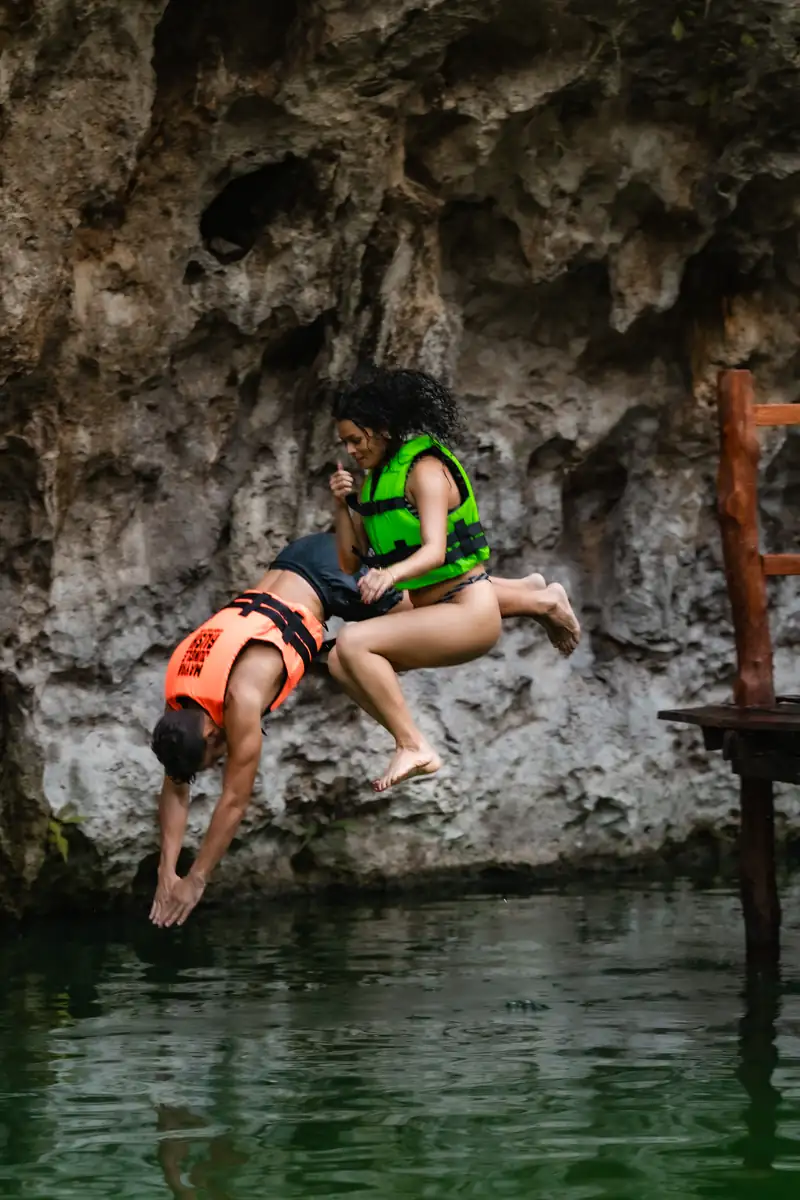
- Jump only where it is allowed, and look before you leap.
- Stay in the open, marked swimming areas. Never enter caves or tunnels without trained cave guides.
- Keep it calm. Sound carries in rock basins, and many visitors come for the quiet. Ask before flying a drone or playing music.
For what to pack, see how to prepare for your cenote swim.
What to expect on the Ruta de los Cenotes
The Ruta de los Cenotes is the jungle road that runs inland from Puerto Morelos toward Leona Vicario, a short drive south of Cancún. According to the Quintana Roo tourism board, the route has open, semi-open and closed cave cenotes, so it is one of the easiest places near Cancún to compare the types in a single day.
A few practical points:
- Each cenote is run separately, with its own entrance fee and rules. Check before you go, since fees and hours change.
- Access varies from stairs to ladders, and several sites add ziplines or jumping platforms.
- Bring your own snorkel mask if you want a clear view of fish and formations, and ask about life jackets when you arrive.
If you want a list of specific cenotes, we keep one sorted by distance in best cenotes near Cancún, and our Ruta de los Cenotes guide covers the road itself.
Swim in a jungle cenote with us
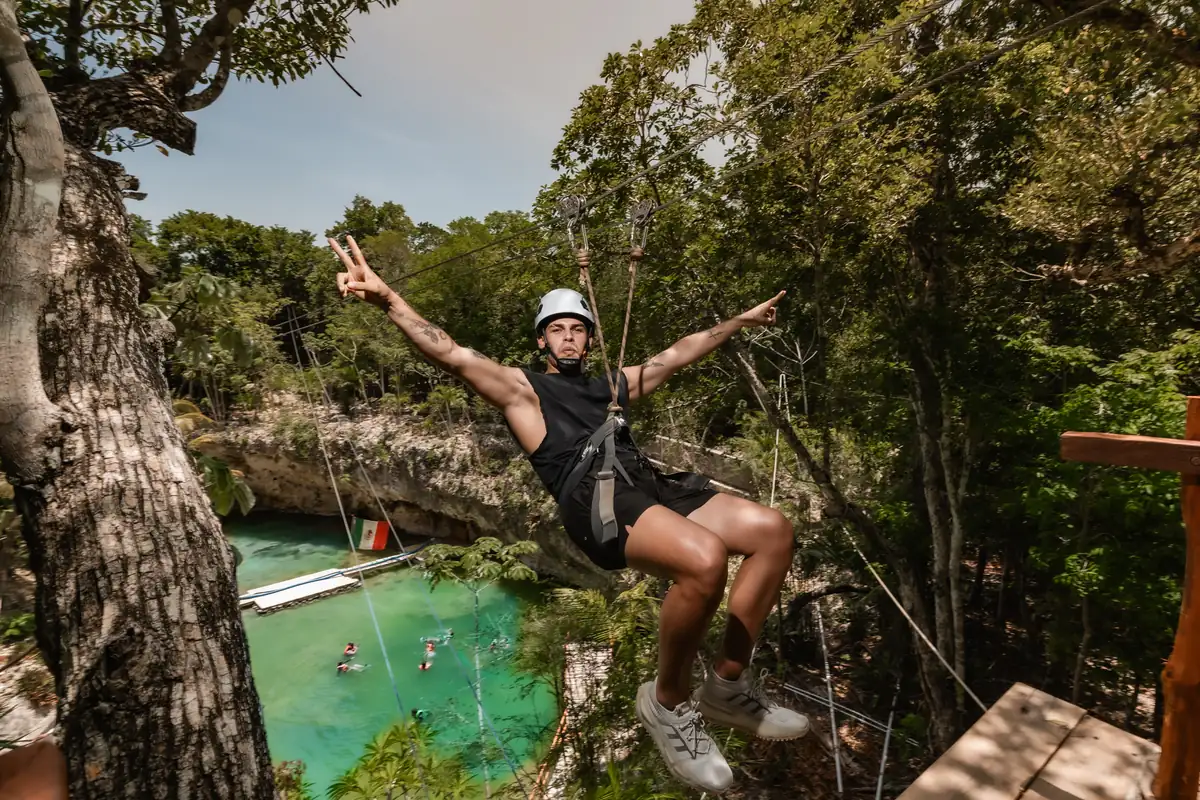
Mayan Jungle Rush sits at km 18.5 of the Ruta de los Cenotes, with hotel pickup from Cancún and Puerto Morelos. Our adults-only Cenote Tour gives you about three hours at a jungle cenote plus a Maya snack. If you are traveling with kids or want more action, our ATV and horseback combos include a cenote swim, and one of our ziplines crosses right over the water.
Frequently asked questions
Which type of cenote is best for beginners?
Semi-open and open cenotes are usually easiest, since they have daylight, more space and often gentle entry points. Wear a life jacket if you are not a confident swimmer.
Which cenotes are the oldest?
In the usual geological sequence, open cenotes are the oldest because their ceilings have fully eroded, and cave cenotes are the youngest.
Are cave cenotes safe for swimming?
The open-water areas that sites designate for swimming are generally fine. The danger is in going beyond them into flooded passages, which only trained, certified cave divers should do.
Why is cenote water so clear?
Rainwater filters through limestone before it reaches the cenote, and cave cenotes get little sunlight, which limits algae. Open cenotes can look greener because sunlight lets plants and algae grow.
Swim in a jungle cenote
Spend 3 hours at our cenote on the Ruta de los Cenotes, with pickup from Cancún.
See the Cenote TourSources
- Cenotes of Yucatán – Yucatán Magazine
- Explore the Cenotes Route of Puerto Morelos – Mexican Caribbean (Quintana Roo Tourism Board)
- Impact of Tourist Behavior on the Discharge of Sunscreen Contamination in the Mexican Caribbean – Applied Sciences (MDPI)
- Speleogenesis: How were caves and cenotes formed? – Emiliano Monroy-Ríos, Northwestern University
- ¿Cuántos tipos de cenotes hay? – Posta México