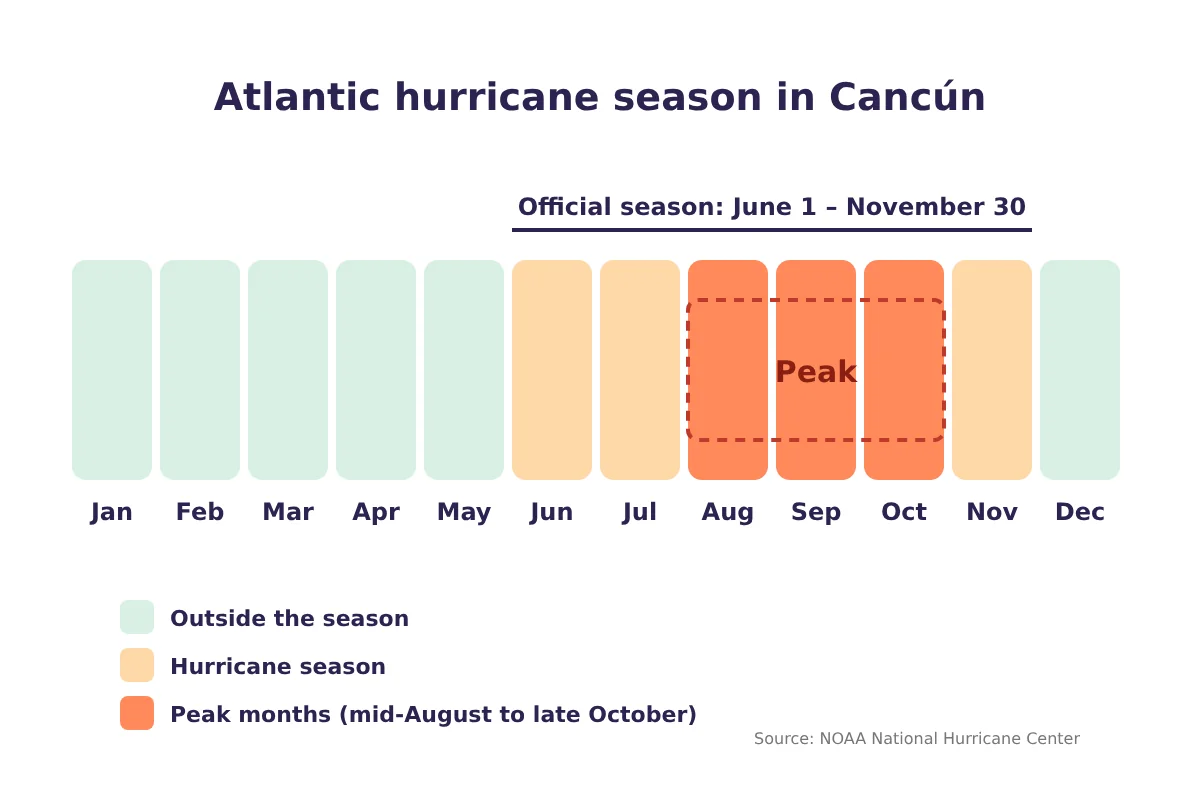
Hurricane season in Cancún follows the official Atlantic season, from June 1 to November 30. Across the Atlantic basin, activity is highest from mid-August to early October, with a statistical peak around September 10. In the western Caribbean, which includes Cancún, October can also be active.
That said, most weeks of hurricane season pass without any storm near Cancún. Direct hits by strong hurricanes are rare events, often many years apart, and modern forecasts give days of warning. If you travel between June and November, you don't need to cancel your trip; you need to understand how alerts work, keep your plans flexible and buy the right insurance.
When is hurricane season in Cancún?
The National Hurricane Center (NHC) has used June 1 to November 30 as the official Atlantic season since 1965, and those dates contain over 97% of the basin's tropical cyclone activity. Mexico's National Meteorological Service (SMN) uses the same season for the Atlantic side of the country.
Within the season, risk is not spread evenly:
- June and July: storms are possible but less common. Hurricane Beryl in July 2024 was an exception.
- August and September: the busiest stretch for the Atlantic as a whole. According to Mexico's water commission, Conagua, August and September together produce just over 60% of a season's tropical systems.
- October: the Atlantic slows down overall, but conditions often favor development in the western Caribbean and the Gulf of Mexico later in the season. Two of the storms below, Wilma and Delta, hit in October.
- November: activity usually winds down.
How often do hurricanes actually hit Cancún?
Less often than many visitors fear. Here are the four storms most often mentioned when people talk about hurricanes in the Cancún area:
- Gilbert (September 14, 1988): a Category 5 hurricane that made landfall on Cozumel and then the Yucatán Peninsula. Storm surge washed away a large share of Cancún's beaches.
- Wilma (October 21–22, 2005): a Category 4 hurricane that hit Cozumel and then the mainland near Puerto Morelos, moving very slowly. A rain gauge on Isla Mujeres recorded 1,634 mm (64 inches) in 24 hours, a record for the Western Hemisphere. Most Cancún resorts were open again within about a year.
- Delta (October 7, 2020): made landfall near Puerto Morelos as a Category 2 hurricane with winds of about 175 km/h (110 mph).
- Beryl (July 5, 2024): made landfall north of Tulum as a Category 2 and weakened quickly over land. Tulum and southern Quintana Roo were hit harder than Cancún.
Four notable storms in more than 35 years does not mean nothing else happened; tropical storms and weaker systems bring heavy rain and wind more often. But it shows that a major hurricane hitting during your particular week is unlikely.
How do hurricane alerts work in Mexico?
You will hear about storms from two main sources:
- The US National Hurricane Center (NHC) issues forecasts, track maps and advisories for the whole Atlantic, in English.
- Mexico's National Meteorological Service (SMN), part of Conagua, issues the official forecasts and warnings for Mexico.
On the ground, Mexico uses an early warning system for tropical cyclones (SIAT-CT), in place since 2000 and coordinated through the national civil protection system. People often call it the semáforo (traffic light). It has five colors, and Quintana Roo's civil protection authorities announce the level for each municipality:
- Blue (azul), minimal: a storm is more than 750 km away, with possible effects in more than 72 hours. Stay informed.
- Green (verde), low: 350–750 km away, possible effects in 24–72 hours. Review your plans.
- Yellow (amarilla), moderate: 200–500 km away, possible effects in 12–60 hours. Shelters are prepared; know where to go and be ready to move.
- Orange (naranja), high: 100–400 km away, possible effects in 6–36 hours. Shelters open, risk zones are evacuated, and boating and outdoor recreation stop.
- Red (roja), maximum: the storm's winds are affecting the area or expected within about 18 hours. Stay sheltered and follow instructions.
As a storm moves away, the system steps back down through the colors, with warnings about flooding and other after-effects.
What happens to hotels and tours during a storm?
If a hurricane threatens, follow the instructions of your hotel staff and of Protección Civil, which can include moving to an official shelter at the orange or red level. Ask your hotel about its storm plan when you check in during hurricane season. Keep your passport, medication, phone, charger and some cash together in a waterproof bag.
Outdoor tours, boat trips and ferries stop when conditions are unsafe, which can include the days just before and after a storm. Our own policy is simple: if we cancel a tour because of bad weather, you can reschedule or get a full refund. That is part of our terms. If you are unsure whether your tour is running, message us on WhatsApp at +52 998 368 9067.
For ordinary rainy days, which are far more common than storms, see our list of things to do in Cancún on a rainy day.
Should you buy travel insurance for hurricane season?
If you travel between June and November, it is worth considering. A few things to know:
- Buy early. Most policies only cover a storm if you bought the policy before it was named, usually at least 24 hours before. Once a storm has a name, it counts as a "foreseen event" and is typically excluded.
- Read the triggers. Policies usually pay for cancellation only in specific cases, such as a hurricane warning at your destination, a mandatory evacuation, an uninhabitable hotel or an airline cancellation. Being in a storm's forecast path is usually not enough.
- Consider "Cancel For Any Reason" (CFAR). It costs more and reimburses only part of your costs, but it lets you cancel simply because you are worried. It usually must be bought within 14 to 21 days of your first trip payment.
- Check your other bookings. Airlines may issue travel waivers before major storms, and many hotels have their own policies. Book refundable or flexible rates when you can.
Always confirm the details with your insurer; terms vary.
Are there advantages to traveling in hurricane season?
Yes. Late summer and fall are usually quieter in Cancún than the winter high season, so you often find fewer crowds and better hotel deals. The sea is warm, the jungle is green, and cenotes are a good escape on hot afternoons.
To compare seasons month by month, read our guide to the best time to visit Cancún. Sargassum is a separate, unrelated issue with its own season; our sargassum guide covers it.
Planning a jungle tour in hurricane season
Our tours take place at km 18.5 of the Ruta de los Cenotes, near Puerto Morelos, and last about four hours, with pickup from Cancún and Puerto Morelos hotels. If the weather makes a tour unsafe, we cancel it, and our bad-weather policy applies: reschedule or full refund. See all options on our tours page or check hotel pickup details. New to the area? Start with first time in Cancún: things to know.
Frequently asked questions
What months are hurricane season in Cancún?
The official season runs from June 1 to November 30. The Atlantic is most active from mid-August to early October, and October can also be active in the western Caribbean.
Is it safe to travel to Cancún during hurricane season?
Generally yes. Most weeks pass without any storm, forecasts give several days of warning, and Mexico has a well-established alert system. Stay informed, keep plans flexible and buy insurance early.
When was the last hurricane in Cancún?
Recent storms that affected the area include Hurricane Delta, which made landfall near Puerto Morelos in October 2020, and Hurricane Beryl, which made landfall north of Tulum in July 2024. Check the NHC and SMN for current conditions.
What happens to my tour if a hurricane is coming?
Outdoor tours are canceled or rescheduled for safety. With us, if we cancel for bad weather, you can choose a new date or a full refund.
Explore the jungle near Cancún
ATV, ziplines, a cenote swim and a tequila tasting on the Ruta de los Cenotes, with pickup from Cancún.
See All ToursSources
- Atlantic hurricane season (Wikipedia)
- Agosto y septiembre, periodo con mayor actividad ciclónica: Conagua (El Quintana Roo)
- Effects of Hurricane Wilma in Mexico (Wikipedia)
- Hurricane Delta update, October 7, 2020 (National Hurricane Center)
- Sistemas de alerta temprana: SIAT-CT (Gobierno de México)
- Does travel insurance cover hurricanes? (Squaremouth)